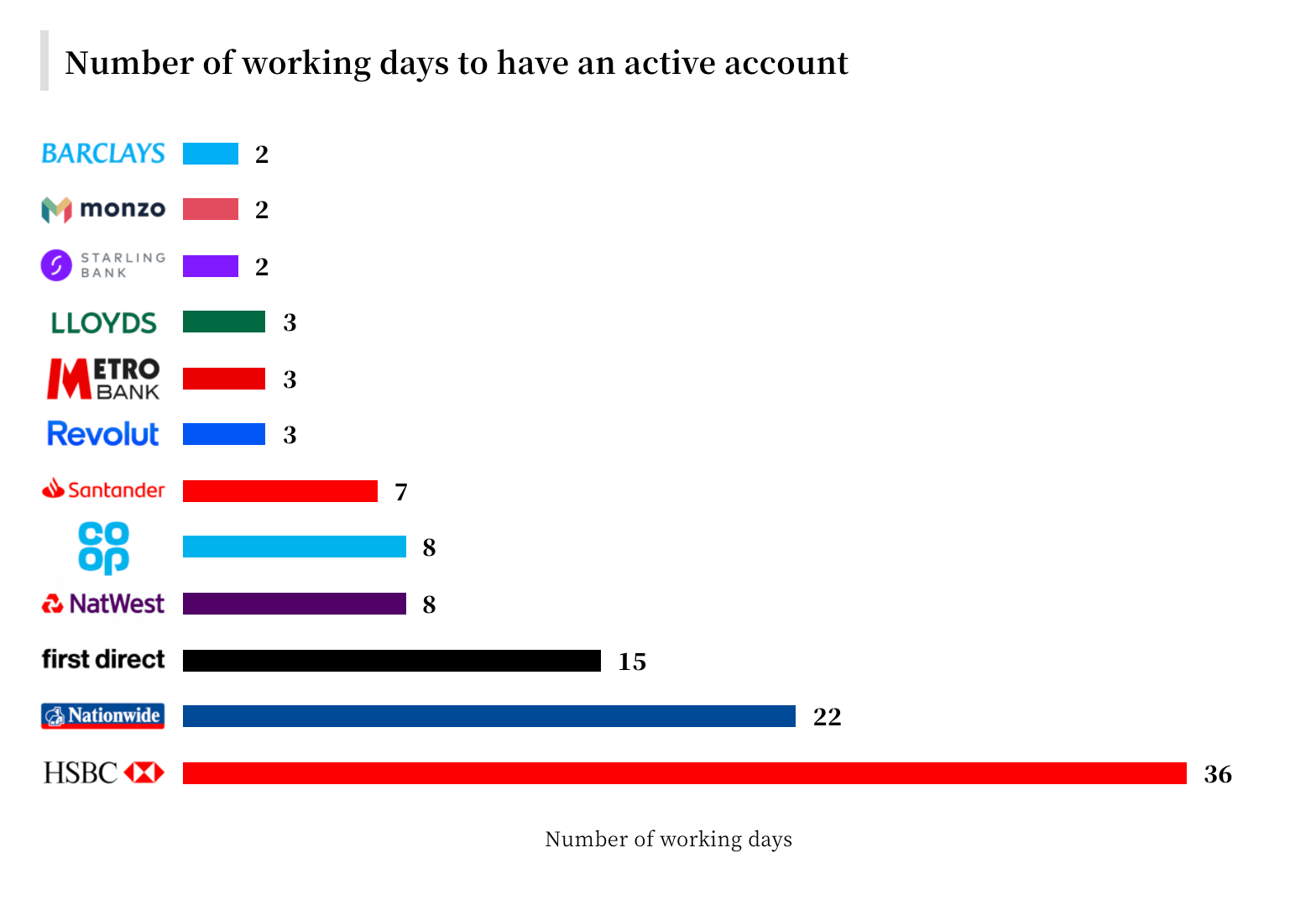
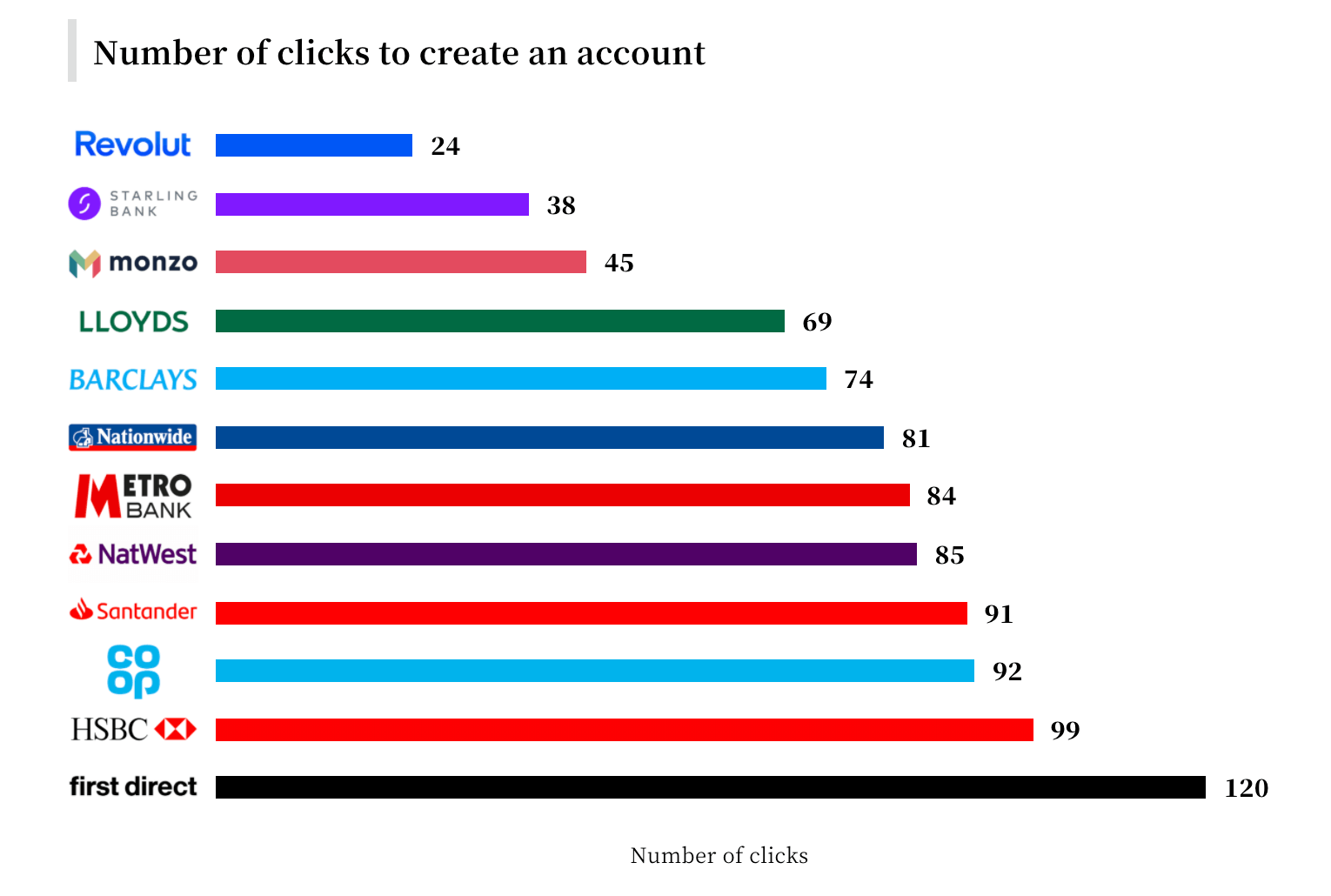
Let's look at a practical example from the banking sector of how transformation fuels growth. This usability research on the UX of banking involved competitor benchmarking where different activities like opening an account were logged and compared.
This study highlights the digital disruption caused by challenger banks and how some industry incumbents have improved their customer experience, but others haven't. The findings are shocking... Look at the difference between the 10+ days for an account to become active from existing banks in comparison to the 2-3 days for an account to be active from challenger banks like Monzo, Starling and Metro.
To follow an established process for digital transformation strategy, we recommend combining the Smart Insights RACE planning system and PR Smith’s SOSTAC® Planning Model.
SOSTAC® is a widely used tool for marketing and business planning which is rated in the top three most popular marketing models in our review of Marketing Models that have stood the test of time. The SOSTAC® process covers six steps which apply well to managing digital transformation:
- Situation Analysis
- Objectives
- Strategy
- Tactics
- Action
- Control
Created in the 1990s by writer and speaker PR Smith, the SOSTAC® framework has built an authoritative reputation as the framework of choice for different scales of business including multinational and start-up organizations across the world.
The six parts of SOSTAC® don't give specific details on which digital transformation activities should be worked on, however, our SOSTAC® Digital Marketing Planning Guide advises on this.
Smart Insights RACE explains the detail needed to prioritize digital marketing activities since it gives a comprehensive definition of 25 activities that should be considered for prioritization on your digital transformation roadmap. These are summarized in this infographic which explains how the SOSTAC activities relate to RACE.
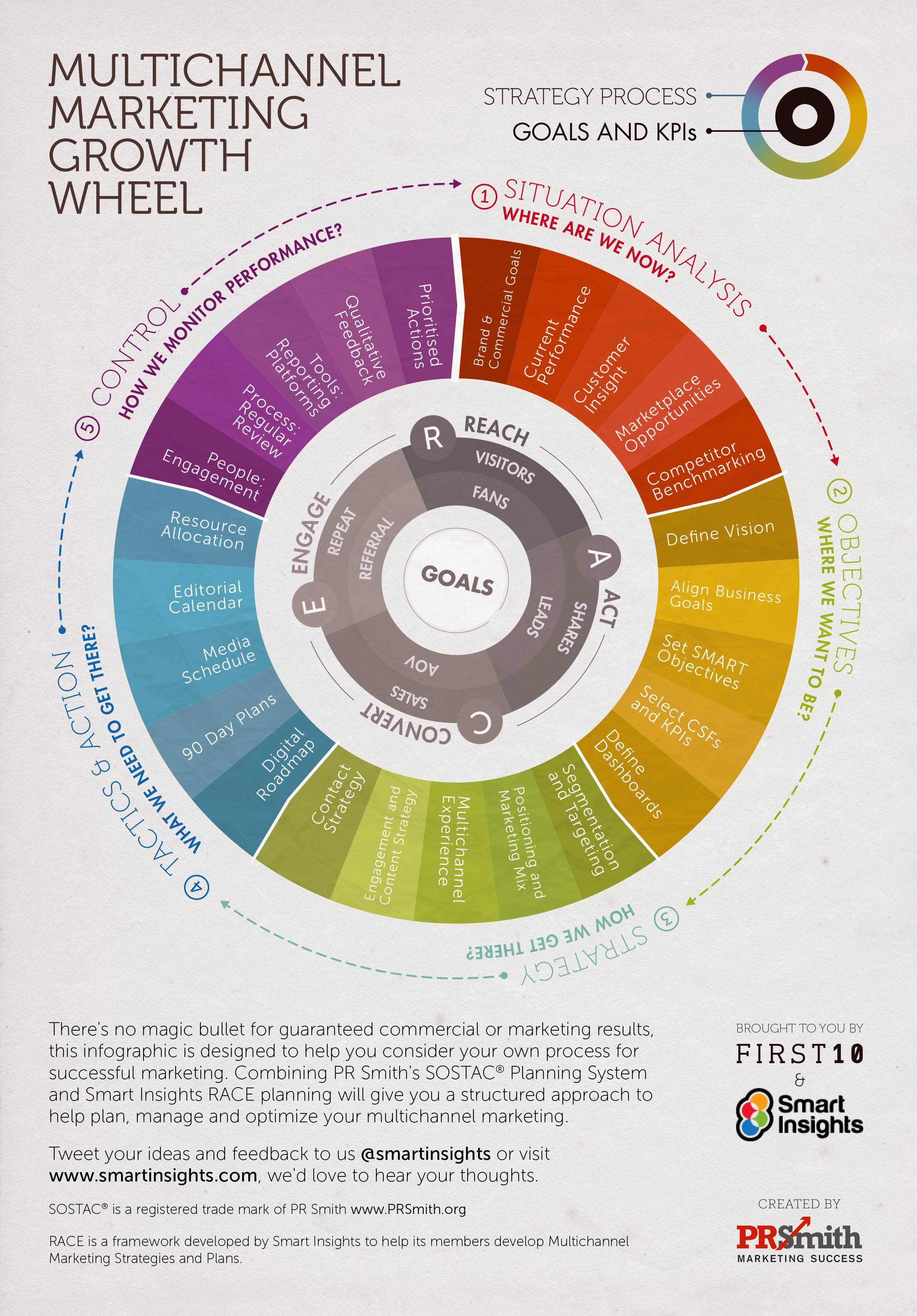
Let's now consider the digital transformation activities involved in each step...
Stage 1. Situation analysis and performance review
This review should assess opportunities for deploying digital marketing and technology in your organization and reviewing the limitations involved. Analysis of your digital activity compared to competitors should be part of this. Activities to include at this stage are:
- SWOT analysis: what are the strengths, weaknesses, opportunities, and threats to the whole organization? We recommend a digital-specific or multichannel digital channel SWOT - see examples.
- Who your digital customers currently are: What types of audience personas interact with you? You can see more examples and guidance in the Smart Insights Persona Toolkit.
- Competitor analysis: How do they compete online across the 5Ds of digital? e.g. price, product, customer service, reputation, what are their key differentiators?
- Digital channel performance: What is the effectiveness of different channels such as search, social media and email marketing in supporting acquisition?
Stage 2. Objectives
Stage 2 of your digital transformation plan should define the objective/s of your transformation strategy. Consider the 5 Ss goals refer to Sell, Serve, Speak, Save and Sizzle as SMART objectives.
We recommend that objectives are clearly aligned with strategies to achieve your goals. Drivers of these objectives include business goals and market research insight. Key performance indicators (KPIs) should also be detailed.
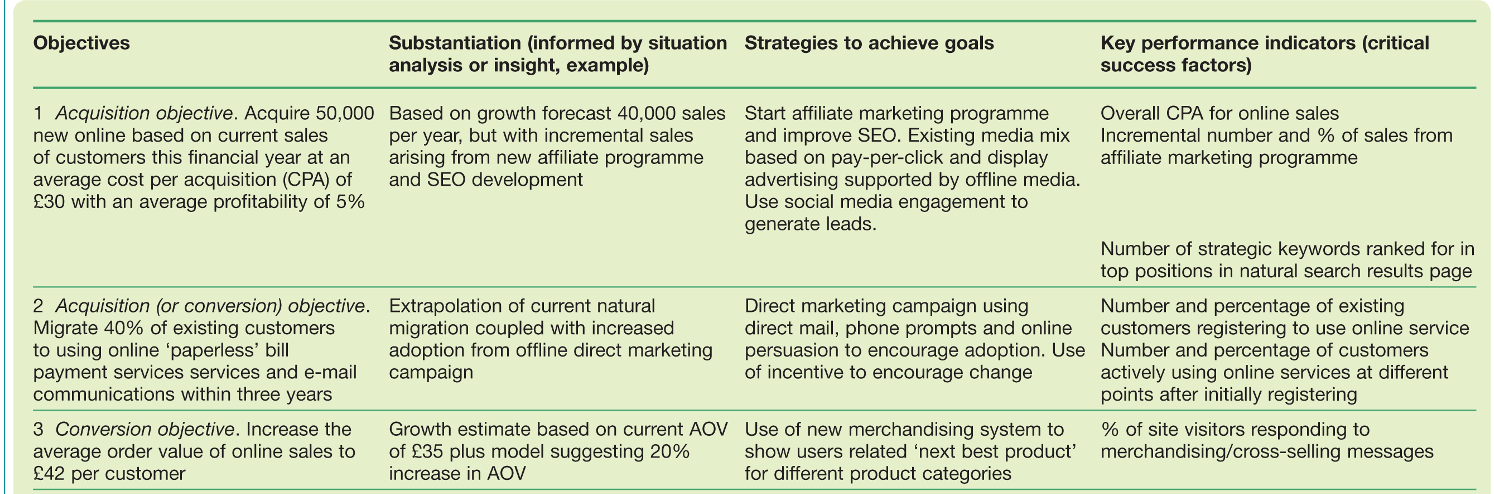
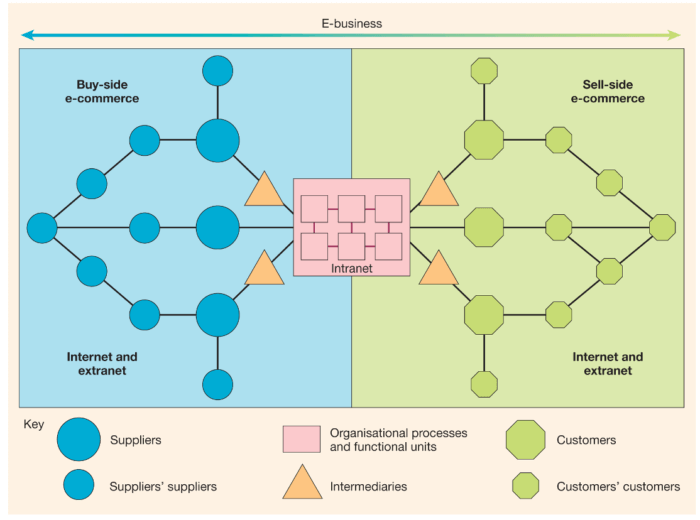
The scope of digital transformation strategy
Source: Digital, Marketing, Strategy, Implementation and Practice, 7th edition, by Dave Chaffey and Fiona Ellis-Chadwick
Objective setting relates to the control stage where it's important to use the right dashboard and performance review approach to improve performance.
Stage 3. Strategy and governance
Strategy defines how you plan to achieve the objectives set for customer acquisition, conversion and retention.
For transformation projects, you need to select strategic initiatives to achieve your goals. Decisions about investment, resourcing and governance which are also highlighted in the action section.
The Deloitte CMO survey highlights how transformation projects can support business growth strategies business:
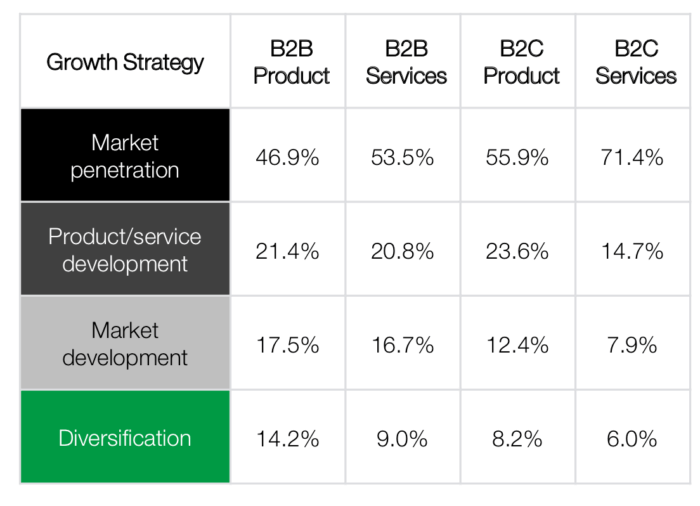
Typically, much investment in digital marketing communications is focused on market penetration of existing products into existing markets. However, transformation strategy should also consider more disruptive strategies to support product development and market development.
Digital technologies give opportunities for digital or digitally augmented services to enter new geographic or customer markets at a low cost. So transformation strategy relates closely to market segmentation, targeting and positioning (STP) strategies. These will require review of business and revenue models related to the 4Ps including Product, Place, Pricing and Positioning.
Writing on LinkedIn, Andrew Annacone, Managing Partner at TechNexus Venture Collaborative recommends there are four types of transformation to consider:
- Business process: Improving the efficiency of selling and buying processes and communications (he doesn't acknowledge marketing as a process...)
- Business model: Opportunities for digital sales
- Domain: This relates to opportunities for new product development and market development
- Cultural/organizational: Highlighting the need for careful change management, skills development and restructuring
Digital governance
Governance is a key success factor for digital transformation projects covering issues such as resourcing, skills development, team structure, performance review and improvement process. Digital government also covers how these activities are supported by marketing technology. The McKinsey 7S framework provides a useful way to review these governance decisions.
Stage 4. Tactics
Tactics cover the specific tools of the digital mix that you plan to use to realize the objectives of your plan. In practice, these tactics are delivered as 'always-on' digital communications across the customer lifecycle. Planning in these integrated digital and traditional communications which go beyond marketing campaign communications are needed to make the most of the opportunities of digital marketing, yet they are often missed if a structured transformation approach hasn't been followed.
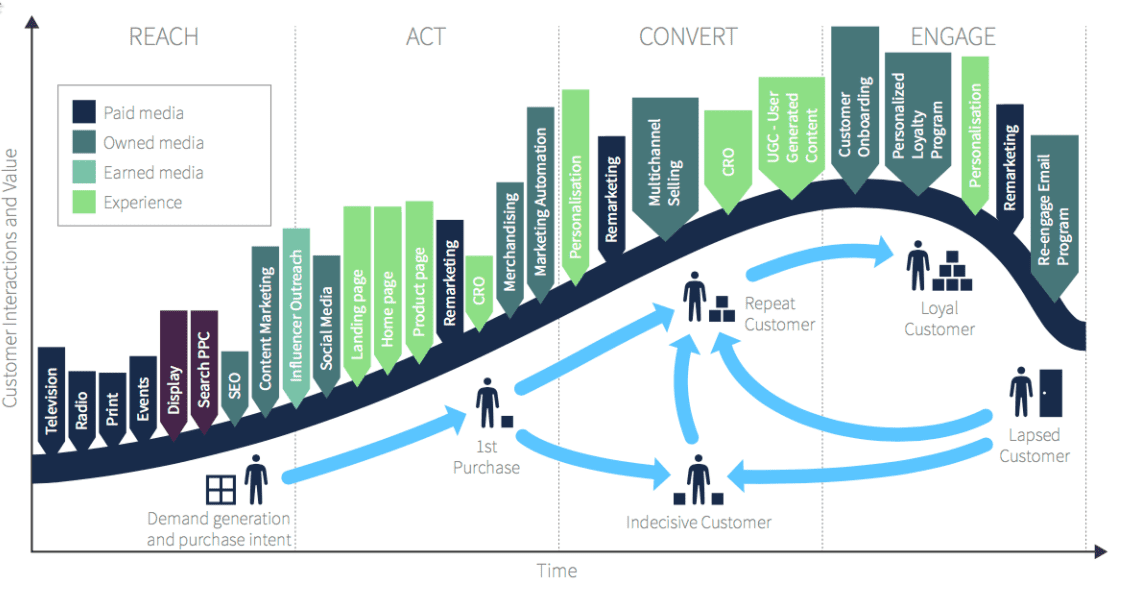
As our customer lifecycle analysis visual shows, 'always-on' paid, earned and owned digital media are particularly important. If you can encourage initial interactions with a brand based on search intent to buy a product, there are opportunities to design integrated communications to influence audiences throughout the customer lifecycle using email automation, web personalization, and re-targeting.
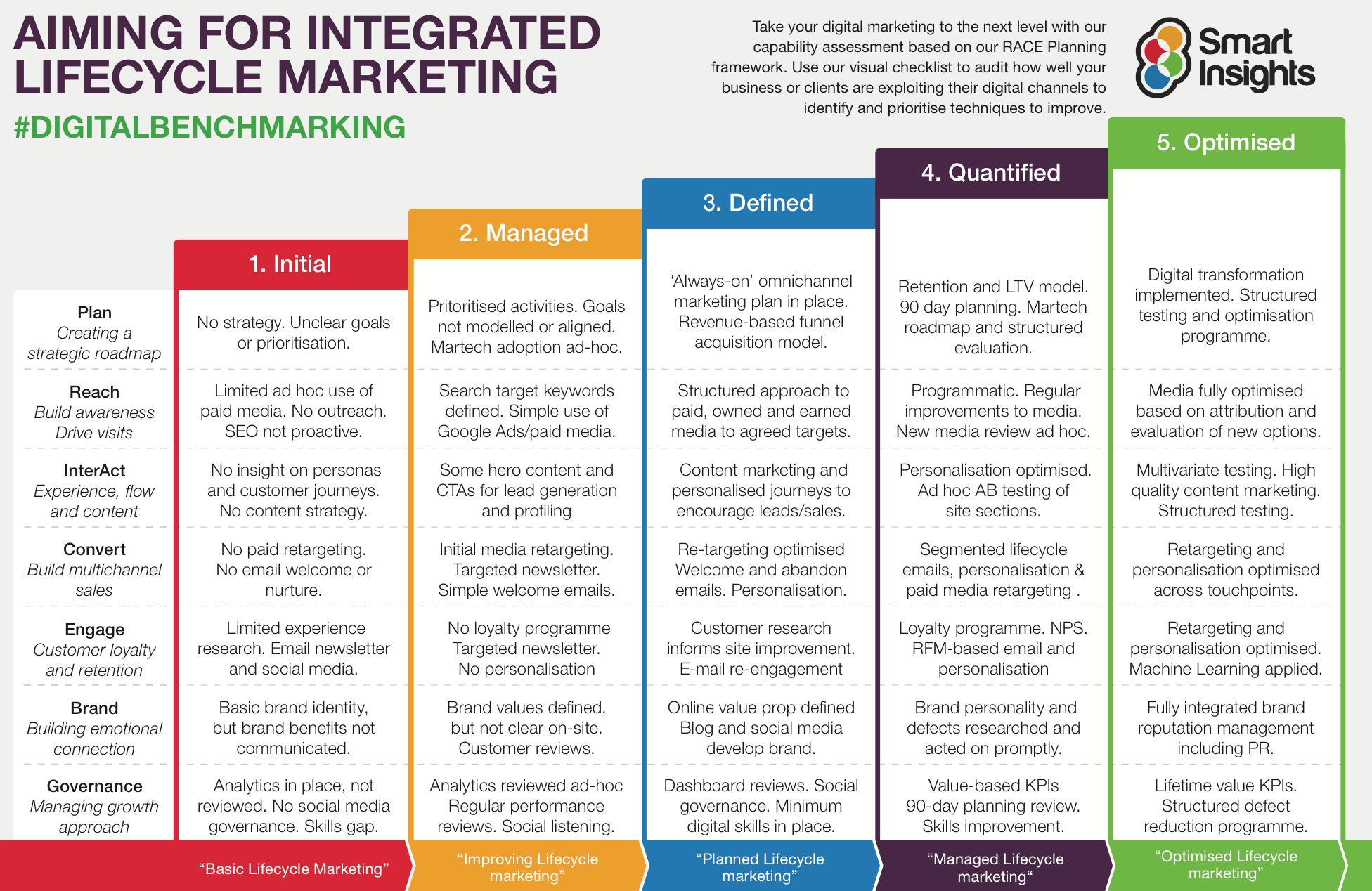
When completing your performance review you will need to have considered your existing capabilities to deliver these. Access our free digital marketing benchmarking templates to review your performance across RACE.
Our six pillars of success are based on what we have often seen to be missing parts of the planning puzzle when consulting and training with many companies from small to large.
The six pillars of success for digital marketing tactics
To simplify this complexity from the hundreds of tools and communications channels to potentially use, we recommend six key pillars for success for implementing transformation which must be sufficiently resourced and a dedicated strategy created. These are shown in the visual.
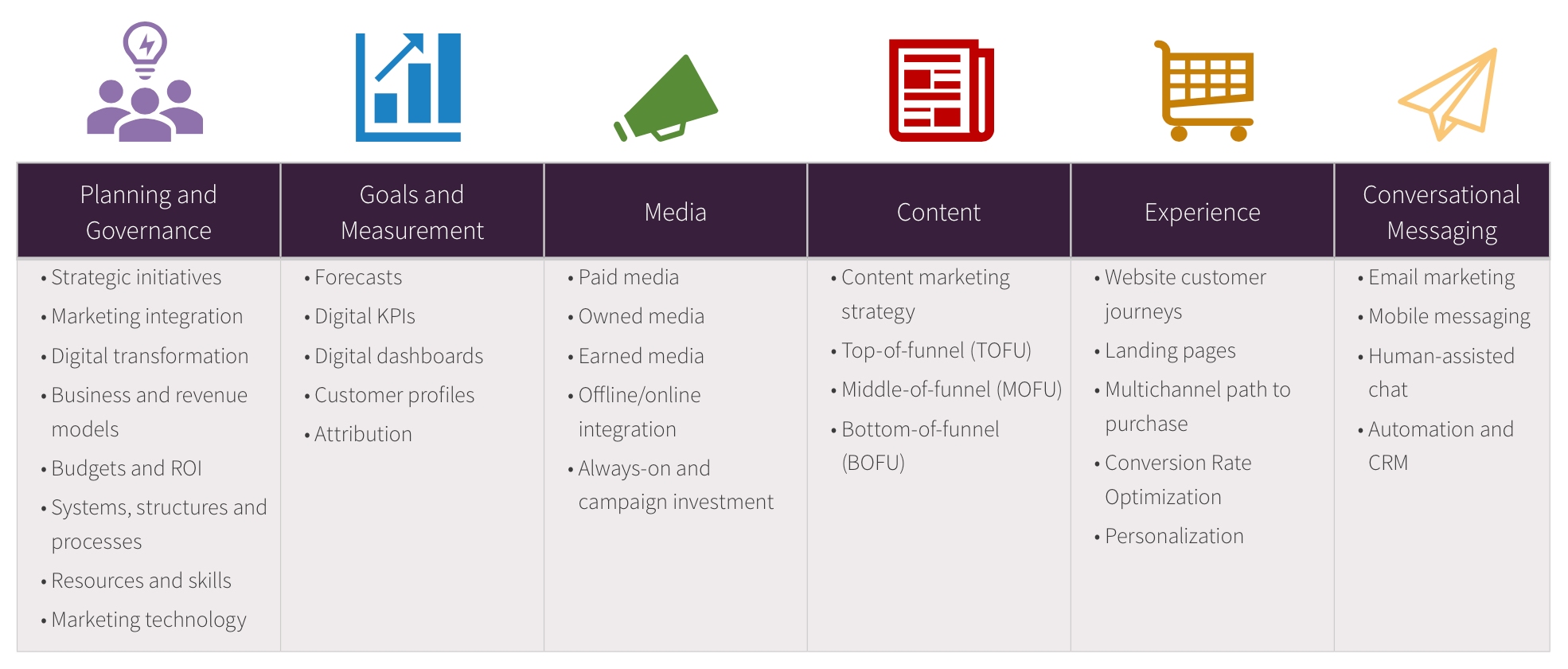
Key activities for the six digital pillars
The first two pillars relate to Objective setting and Control. Governance should be considered as part of strategy. The other tactics are four key implementation factors. For each, we recommend guides and templates our premium members can use to learn more.
1. Planning and governance
2. Goals and measurement
- What? Customizing goals in Google Analytics and integrating data from different sources into a reporting dashboard system for quarterly, monthly, weekly or daily review
- Why? Using a data-driven performance review system helps review your always-on and campaign-based activities to regularly review performance against target and then to take actions to drive growth. Many businesses haven’t customized analytics goals sufficiently.
- Deliverables: Google Analytics audit and digital marketing dashboards
3. Media
- What? Using always-on paid, owned and earned digital media to generate brand awareness and drive targeted initial website visits and repeat visits. Update campaign process playbooks
- Why? Always on media investment is essential to tap into customer intent as they search for products and services and review on social media and publisher sites
- Deliverables? Customer acquisition plan. Updated campaign plan and editorial calendar plans
4. Content marketing
- What? A defined content marketing strategy engages and converts prospects provided content is surfaced via the website experience through clear customer journeys
- Why? Quality content fuels search, social, email and PR activities and support conversions
- Deliverables? Content audit. Content marketing strategy. Content distribution plan including influencer outreach.
5. Digital Experience (website)
- What? Company websites (and mobile apps where relevant) are at the heart of marketing since they position your brand to support online and offline lead generation and sale
- Why? Websites often fail to provide clear customer journeys, emphasize brand value and differentiation or surface relevant content recommendations to support purchasers
- Deliverables? Customer personas. Website effectiveness audit. CRO plan.
6. Conversational messaging
Stage 5. Action
Stage 5 is focused on turning your plan into action. The action section covers what needs to be achieved for each of the tactics listed in the previous sections of the SOSTAC® plan to realize the objectives of your digital marketing plan.
This will include project plans and roadmaps of activities as recommended in our transformation toolkit.
Change management plans are a key success factor for transformation since staff need to be fully involved and informed as changes introduced will affect their way of working. Our change management for digital transformation recommends best practice approaches.
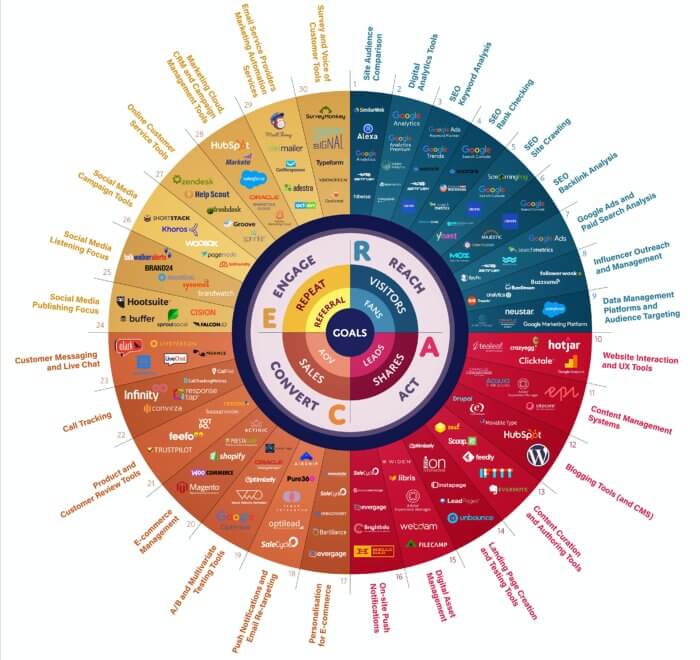
It will also include consideration of your marketing technology stack as described in our guide to marketing technology selection.
Stage 6. Control
The final stage is to lay out how you plan to monitor and measure your performance based on the objectives set at stage 2. We recommend using a digital marketing dashboard structured around RACE which will enable you to review performance of digital channels in achieving leads and sales month-on-month and year-on year.
Our RACE digital marketing dashboard in Google Sheets is used by our premium members to review performance based on an API integration with Google Analytics.
Summary - your digital transformation strategy success factors
Success in transformation requires sufficient investment in digital marketing activities. We recommend transformation projects ensure sufficient investment across these six pillars:
- Digital marketing governance or management: Governance defines the resources and infrastructure needed to develop strategies, action plans, resources, budgets, and KPI dashboards to test, learn, refine, and integrate all marketing and sales communications. Key infrastructure investments are marketing technology, data, insight and optimization.
- Digital goals and measurement. Setting SMART objectives and defining goals in analytics for regular review and corrective action using digital marketing dashboards.
- Digital media: Grow awareness through integrating paid, owned, and earned media with sufficient investment to gain visibility as customers search for your products and services.
- Digital content marketing: Create quality, sector-leading content to fuel all your marketing activities from search to social to email marketing.
- Digital customer experience: Optimize websites, apps, and company social media pages. Integrate your digital marketing with customer-facing sales and support staff to engage, explain, and convert.
- Digital messaging or ‘conversation marketing’: Deploy personalized communications to welcome, educate, and nurture prospects and customers across websites, email marketing, and mobile notifications.
In our experience of reviewing organizational digital capabilities as part of digital transformation projects, we find that there is often a listless approach to improving digital marketing. Once projects are completed, pages are implemented or products launched, it’s easy to feel that the job is done. This thinking is transferable to in-house digital marketing skills and processes. It’s critical that you ask yourself regularly: “This is how we’re doing it now, but what can we do to improve?”
Here’s a summary checklist of 10 key success factors for digital transformation that you need to communicate as part of your vision of how an organization needs to change in the future:
-
1. Management and governance: Engaging all relevant stakeholders to define a vision for how digital can strengthen the organization. Setting goals and selecting costed digital initiatives in a prioritized roadmap that align with your business strategy.
-
2. Brand development: Digital media and data should enhance your brand, by designing and developing a digital value proposition for your target audiences that complements your existing brand characteristics and counters digital disruption in your sector.
-
3. Integrated lifecycle communications activities: Digital is sometimes treated as a silo, but customer journey and contact strategy should select relevant paid, owned and earned media activities across digital AND traditional communications. These include both ‘always-on’ and campaign communications.
-
4. Content: The quality of digital and physical content and how it is surfaced at different points in the customer journey through relevant website design and content distribution channels like search, social, and email marketing is the most important practical factor in increasing reach and persuasion.
-
5. User experience: Research shows that a poor website experience will result in lost business and a lack of engagement with internal stakeholders. So benchmarking and reviewing both product and relevant digital experience through voice of the customer (VoC) and surveys is a key part of transformation. The website, increasingly accessed by smartphone, is traditionally the key digital experience alongside email marketing. Social media platforms are often the main experience of a brand online in some sectors, particularly as social networks like Facebook and LinkedIn seek to own service transactions between brands and their customers.
-
6. Resourcing: People, organizational structures and agencies. You will have some digital specialists and agencies, but as part of transformation, it’s important to ensure digital marketing competencies are developed across the organization through skills audits and training.
-
7. Change management: Digital transformation should be an organization-wide initiative which will be implemented over a period of several years. So ensuring your teams understand the why, what and how of transformation and the impact on their work is important.
-
8. Improvement process: We believe in a data-driven approach to improvement which requires relevant insights from digital analytics and audience research to inform structured testing such as AB testing to improve the effectiveness of your communications.
-
9. Data and insight: Digital interactions generate vast quantities of data, but this is only of value if it is applied to improve the customer experience and your results. So defining a process for combining digital analytics with customer and market research is needed.
-
10. Marketing technology: This is the last factor since selecting the right systems is most important as an enabler to support your digital transformation strategy.
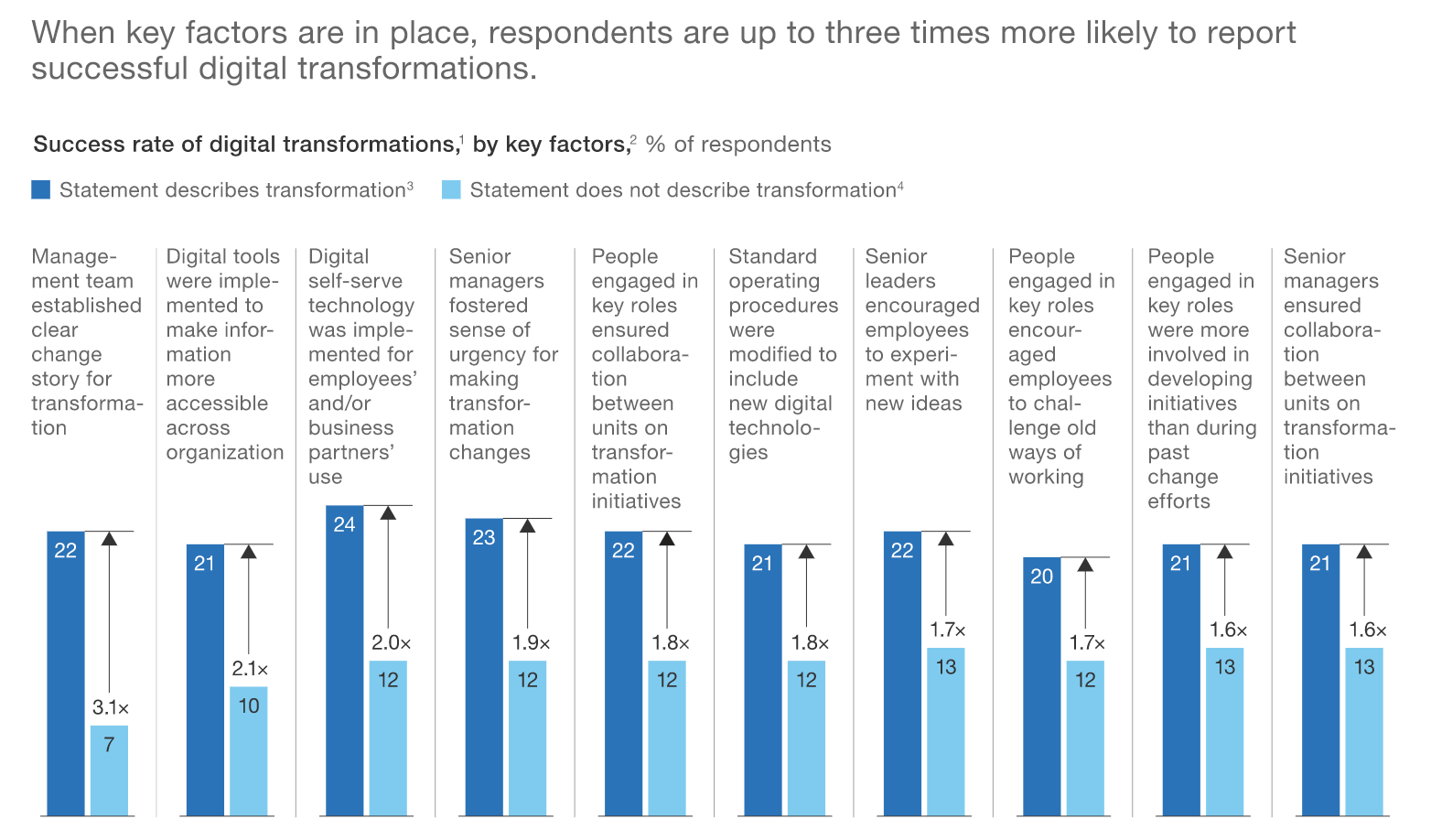
These success factors are consistent with McKinsey research on unlocking success in digital transformations which highlights the importance of senior involvement for governance and to support change management and collaboration.
How can Smart Insights help?