Struggling with a small SEO budget? Here are five tips to help you get more bang for your buck.
Every business, big or small, should be thinking about SEO. In a world where it is becoming increasingly difficult to gain visibility online without paying for it, SEO remains the one true organic marketing channel. But things that are organic are not necessarily free.
While SEO clicks are by definition ‘non-paid’, the process of getting those clicks almost always carries an indirect cost; whether that’s an investment of your own time, staff costs, agency or consultancy fees, tools, training, or a combination of these things and more. SEO - or at least good SEO - rarely comes cheap.
Download our Free Resource – 10 business-limiting SEO mistakes
Discover some really common mistakes we have seen again and again as we have worked on SEO consulting and training projects.
Access the
For businesses on tight budgets, this makes prioritization crucial. Knowing where to cut costs and where to invest efforts can make a big difference to your return on investment. With this in mind, here are five tips for getting the most out of a modest SEO budget.
1. Refine your keyword strategy
When it comes to thinking about what keywords you’re going to target, you need to be realistic. Before you start rolling out a keyword strategy, take some time to understand the SERP (search engine results page) landscape in which you are intending to compete.
Chances are, no matter what terms you’re looking to target, competition for a coveted top-of-page-one position is going to be tough, particularly for broad, high-volume terms. Therefore, targeting long-tail alternatives can be a much better option.
Long-tail keywords are typically three or more words in length and are very specific. While average monthly search volume is often low, so too is the competition. The quality of these keywords is often higher, which can lead to improved conversion rates.
For example, a small bike shop based in East London would probably find it more difficult to gain traction for the term ‘bike shop’ (short-tail) than it would for ‘bike shop in Hackney’ (long-tail).
You can see from the number of Google results below how drastically competition varies between these two example terms.
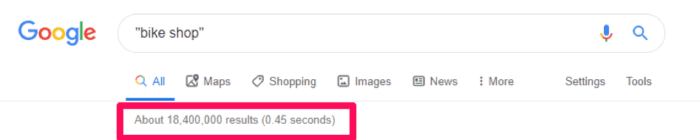
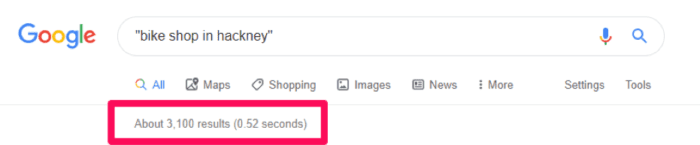
By optimizing for the former, the store will be competing with every other bike shop on the internet. By targeting more specific, long-tail alternatives, the store is entering a race it actually stands a chance of winning.
There are numerous tools available for identifying long-tail keyword ideas - some of which I’ll cover in a bit more detail later in this post - but first things first, here are some tips for honing your long-tail keyword strategy.
- Diversify: Don’t hang all of your hopes on one specific term, this will only lead to a website that reads like it was written by a robot. Instead, consider all of the different keyword permutations and incorporate these, naturally, into your website’s content.
- Start with the low-hanging fruit: Try to identify long-tail keywords for which your site is already getting high impressions but low clicks, as this might suggest that a small boost in visibility could yield a decent click return with minimal effort. You can find all of this information in Google Search Console’s Performance reports.
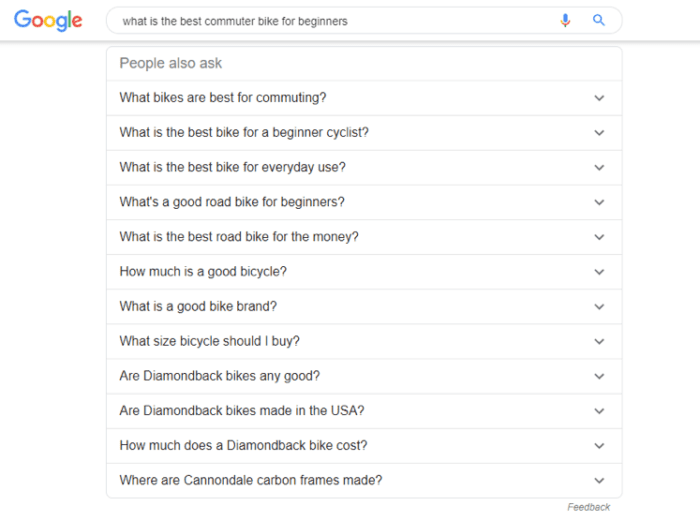
- Questions and answers: Some of the best long-tail keyword opportunities come in the form of questions. Google’s ‘People also ask’ results are a goldmine for discovering such ideas. Simply start by searching for a relevant question in Google, navigate to the ‘People also ask’ results, then click away. Top tip: these Q&A style keywords make great blog posts.
2. Think local with Google My Business
Local SEO is, quite simply, the process of optimizing your business's online presence for local searches. If statistics are to be believed, almost half (46%) of all Google searchers are looking for local information, and that presents a big opportunity for businesses trying to attract higher-quality website visits.
At the heart of local SEO is Google My Business (GMB), a free tool intended to help business owners manage their online presence. It literally takes minutes to claim a GMB listing and fill out the necessary details (address, business hours, contact details, etc.) but the benefits of doing so can be significant.
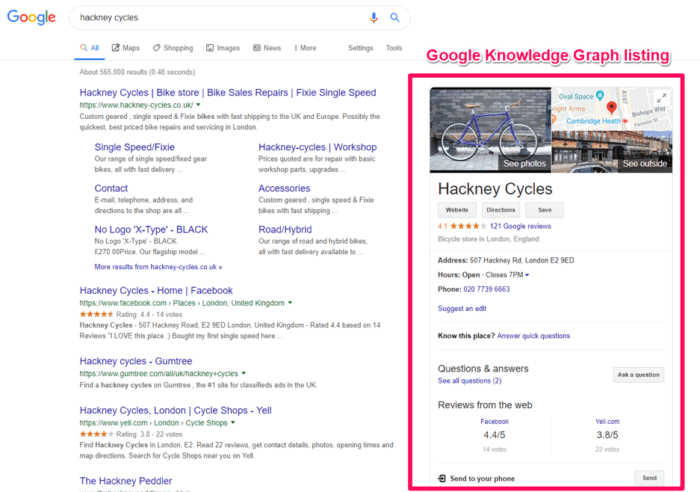
A good GMB listing helps put your business on the map - literally. Verified GMB information is utilized by Google’s Local Search results and Google Knowledge Graph, as shown in the two screengrabs below.
Here are the local map results for the search term ‘bike shop hackney’.

And here is an example of a Knowledge Graph result, for the ‘Hackney Cycles’ bike store.
3. Utilize free SEO tools
When it comes to SEO tools, there’s no shortage of options on the market. However, if you want to make use of some of the industry-recognized ‘all in one’ SEO solutions, such as Moz, SEMrush or Ahrefs, you’re going to have to pay a monthly subscription or upfront fee, which is not always an option when you’re working on a tight budget.
The good news is that there are plenty of free alternatives that can give your SEO campaigns a huge boost, without the financial outlay. Whether you're looking to discover new content ideas, inspect on-page elements, or monitor your incoming links, here are a few tools that can help.
Google (multiple)
Google’s extensive suite of free web tools should be on every marketer's radar, not least, Google Search Console. GSC provides invaluable information about keyword performance, page impressions and clicks, indexing and crawl stats, sitemap status, mobile usability, incoming links, and much more.
Beyond that, Google Analytics is an essential tool for measuring website performance. Google Trends is a useful tool for assessing the popularity of search queries over time and in different regions. Finally, the aforementioned Google My Business is a must-have for businesses looking to claim a local SEO presence.
Answer the Public
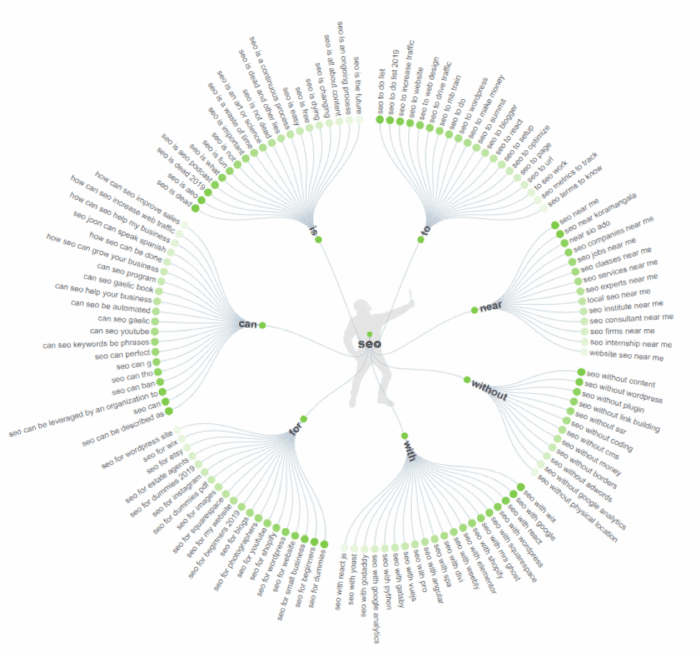
Unlike many keyword research tools that typically rely on Google’s Keyword Planner data (a tool designed primarily for building PPC campaigns), Answer the Public uses auto-suggest search results from Google and Bing and presents the information in a series of visual charts. A great tool for discovering new long-tail keyword opportunities and content ideas.
Screaming Frog SEO Spider
This website crawler makes it easy to analyze and audit key onsite SEO elements. Use it to analyze page titles and metadata, discover broken links, create sitemaps, and much more. The free version has a crawl limit of 500 URLs, which makes it fine for small sites, but those with bigger properties may want to consider the paid version. This comes in at £149 per year - a small price to pay for such a powerful tool.
IIS SEO Toolkit
In a similar vein to Screaming Frog, IIS is a crawler software that gives you in-depth technical information about your website, along with explanations of the issues and recommendations for fixing them. A great tool for techy people who want to understand more about what’s happening under the hood of their site.
Keywords Everywhere
This browser add-on for Chrome and Firefox shows search volume, estimated CPC (cost-per-click) & competition data for multiple websites… all inside of your browser window.
This is by no means a comprehensive list. Check out Smart Insights’ essential digital marketing tools guide for a more detailed roundup of brilliant marketing tools.
4. Sweat your assets
‘Sweating the assets’ is a fairly clichéd business term that relates to getting the most out of the things you already possess. In an SEO and content marketing sense, it’s a process more commonly known as ‘repurposing’.
When budgets are restricted, repurposing existing content makes perfect sense; it alleviates any guesswork because you already know what content themes perform best, plus there’s minimal work involved because much of the hard work has already been done.
Here are some tips for getting more out of your existing content.
- Change the format: You could take some popular blog posts and combine them into a guide, or vice versa. Detailed articles could be compressed into slides or an infographic. When you publish a new video, write up a transcript and publish it as a blog post. Compile questions from your live chat and create a FAQs page. The options are endless.
- Keep popular content updated: There’s no rule to say you can’t update old content to make it relevant to new audiences. Republishing a popular old article along with some fresh data or insights can be a great way of giving it a new lease of life.
- Write less, promote more: The idea here is that you don't have to keep churning out new content to see results. Keep promoting your most popular work and crucially, constantly be thinking about new and alternative ways of getting it in front of relevant audiences
5. Don’t forget about links
Google uses over 200 ranking factors in its search algorithm to determine how highly a webpage will rank in SERPs. One of the biggest factors is backlinks (links from other websites to yours).
Links hold high SEO value because they represent votes of confidence between websites. In simplest terms, the more authoritative the website is, the more influential the endorsement will be. The more high-quality links you have, the better chance you have of ranking highly in SERPs.
But obtaining links, particularly ones from good quality, trusted websites, is easier said than done - particularly when your budget won’t facilitate a full-blown link building campaign. So here are a few ways of bolstering your link profile without breaking the bank.
- Write some guest articles: Writing thought leadership or advice articles for industry blogs and publications can be a great way of exposing your brand to new audiences, and often you'll get a link for your efforts. Quality and relevance are crucial here; never submit content to low-quality sites just because it’s an easy link.
- Directories: Business directories such as Yelp, Yahoo, and HotFrog can give your SEO a small boost while also putting your business on the map, as can local directories specific to your area, or industry directories tailored to your niche. Always opt for quality and relevancy over quantity.
- Promote your content: Pitching your best content to relevant publishers and influencers can be a great way of acquiring links. If you have an amazing resource people need to know about, make some noise about it!
Final thoughts
As alluded to at the top of this post, when approaching SEO on a tight budget, it’s all about prioritization. Knowing where to hone your efforts and picking your battles accordingly will help ensure you get a better return from your investment.
Matt is an Account Director at
Browser Media, an inbound marketing agency specializing in PR-led SEO & content marketing. Matt has more than 11 years of experience helping businesses implement successful digital marketing campaigns that incorporate everything from technical SEO and link acquisition to content creation and online PR. A B2B specialist, Matt has worked with dozens of businesses from startups to FTSE 250 corporates, as well as clients in the third sector. Connect with Matt on
LinkedIn.