Personalization stats for 2018 and 2019 show that brands can stay competitive only through a personalized approach to every customer
Today more than ever before, customers are critical of the experiences they get. They want brands to treat them as personalities both online and offline. They no longer accept average offerings and consider customer service as a part of the product they purchase. The Salesforce State of Marketing research showed that in 2018 84% of customers required a personalized approach.
Download our Individual Member Resource – Website and e-commerce personalization guide
This guide is aimed at marketing managers involved with making the business case for personalization, looking to plan a personalization implementation or extend their use of personalization.
Access the
Behind the vague concept of personalization stand efforts of multiple departments and considerable investments. So how do you approach personalization the right way? How much to invest and in what particular areas? Salesforce consultants suggest the key components of successful personalization in 2019.
1. Bet more on personalization to win
The latest reports by Monetate and Salesforce show that companies investing in personalization get promising business results. Some 77% of companies that delivered personalized services experienced revenue growth in 2018. This figure is even higher among the businesses that had an advanced personalization strategy (93%). At the same time, only 45% of organizations that didn’t personalize customer experience managed to earn more.
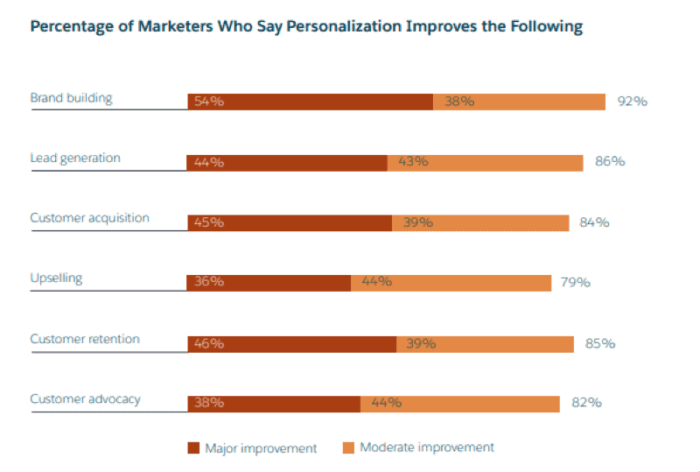
Actually, revenue growth was only one of the positive outcomes that personalization brought. Marketers also saw a positive effect on the entire customer journey, including increased brand awareness, more converted leads and repeat shoppers, as well as better customer advocacy.
These figures show that personalization is no longer a buzzword; it is a winning strategy that brings results to leaders and can leave competitors with more generic approaches behind. A reasonable question is:
How much personalization investment is enough? Is something better than nothing?
Unfortunately, not this time. Let’s look at the leaders again to understand why.
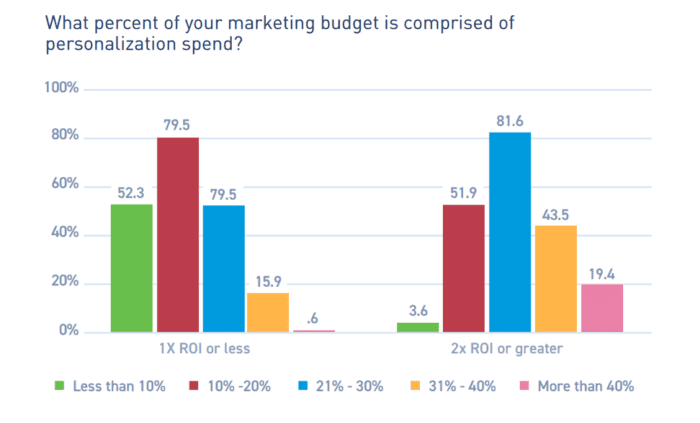
Monetate’s report revealed that companies that allocated more than 10% of their marketing budget to personalization efforts got a higher ROI. In particular, personalization made up 21% of marketing budgets of 86% of the companies getting twice the ROI or greater.
Personalization starts to pay off when you invest enough efforts in it. Although a quarter of the marketing budget is a big chunk, the results prove to be worth it.
2. Don’t underestimate a documented strategy
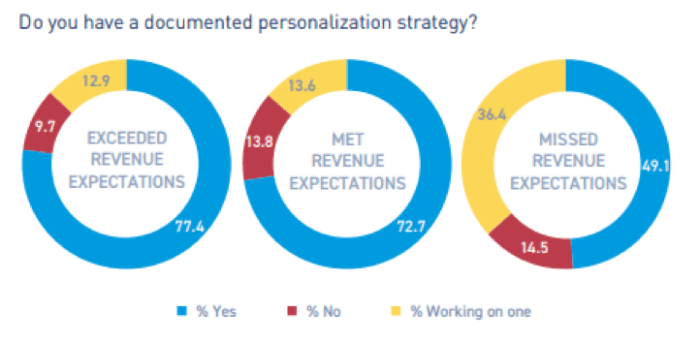
To make sure your investment brings the needed results, you have to tie the efforts to business goals. A documented strategy will help you take better-coordinated actions and monitor returns. According to Monetate’s research, 77% of those companies that exceeded their revenue expectations in 2018 had a documented strategy. At the same time, the companies that didn’t have one were more prone to miss annual revenue goals.
This failure to miss revenue expectations encouraged a third of businesses to prepare a documented strategy for the next year. To avoid such mishaps, it is better to start putting down personalization action plans from day one.
Which metrics to track?
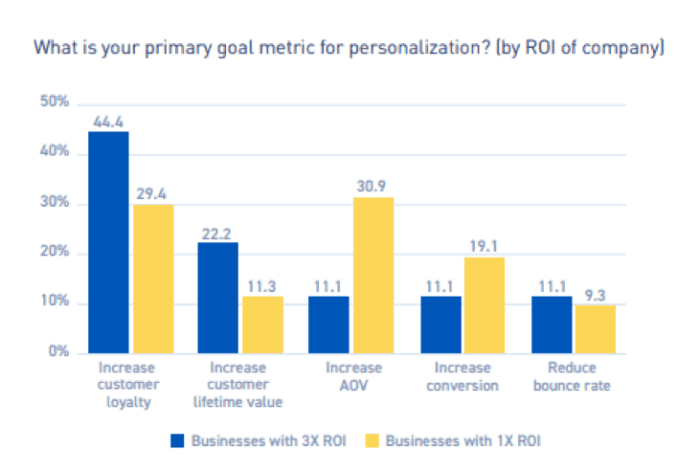
The stats show that companies with the highest return on personalization (three times) tend to focus on the objectives related to building durable relationships, such as on customer loyalty and lifetime customer value. At the same time, the organizations that have a low ROI (one times or less) prefer short-term goals, such as higher conversion rates and average order value, or lower bounce rate.
The takeaway is to focus on a long-term perspective as personalization is not a tool for generating profit immediately. It is a strategy that leads a company to a stable, sustainable growth spread out in time.
3. Customers share their data everywhere − Collect it!
Salesforce’s State of Marketing report showed that 79% of respondents wanted to share data in exchange for contextualized engagement. In particular, 88% of customers expected personalized offers in return.
Shoppers’ demand for better-personalized services stimulates marketing leaders to seek new sources of customer data that are publicly available and tell about prospects’ unique needs and personalities. It is no surprise that the average number of utilized customer data sources is expected to reach 15 in 2019 (compared to 12 in 2018).
What type of data is the most helpful in the leaders’ view?
According to the Evergage report, marketers mostly take into account source (43%), location (39%), and demographics (37%) to personalize communication with customers. Individual parameters, such as products purchased (36%), clicks (33%), and content viewed (32%), as well as website metrics (stages of the customer journey and browsing behavior), are less widely used.
This high-level understanding of every customer is the key to building long-term loyalty and enticing customers to buy more. The only reason for the low adoption of such data is the lack of sufficient processes and technology.
Unfortunately, common sense and motivational phrases (and even financial rewards tied to KPIs) can’t make salespeople put together customer information from various sources for every customer. Perhaps, only the most experienced team members can manage this task, and still, their time is limited while the customer base keeps growing (hopefully). This brings us to the next personalization success factor.
4. Use technology to put together customer data
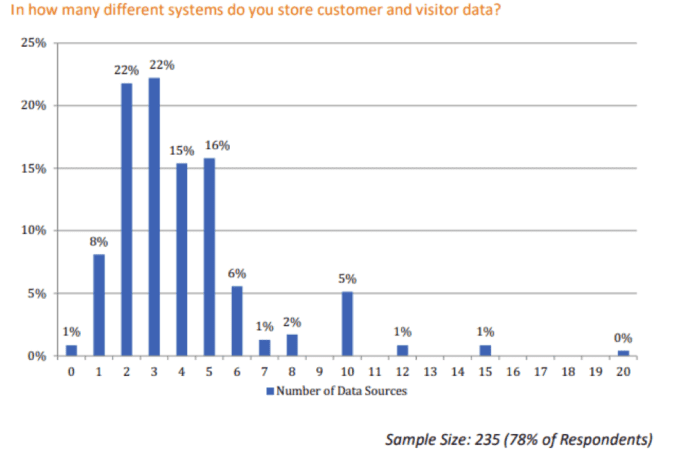
Why do companies (albeit few) investing in personalization fail to get results? Businesses equip their sales, marketing, and service departments with the tools needed to track interactions with the brand, social and web activity, transactions, etc. Yet, in 47% of companies, this information is stored in four or more different systems, which are owned by different departments. As a result, their team doesn’t have a unified view of their customer base.
No matter how well the teams work, they can’t obtain customer data if it’s locked in other systems and, consequently, might annoy shoppers with excessive requests for information or irrelevant offers. Customers perceive a company as a whole and want brands to treat them consistently. This lack of centralized customer data is a great impediment to successful omnichannel personalization.
There are two ways to overcome the problem:
- Integrate customer-oriented tools with each other to let data flow between systems and departments. This way, every team gets complete customer profiles in the systems they work with (like CRM for salespeople). Integration is not an easy task and requires the help of developers experienced in dealing with different types of software. Still, this is a logical choice for companies that already have several tools (perhaps, even custom-built ones) and want to leverage their capabilities.
- Opt for a multifunctional platform solution that can put customer service specialists, marketers, and salespeople into one technological environment, and simplify access to customer data. In this case, platform tools would be integrated with each other out-of-the-box. In addition, all departments could use software with similar UIs, which considerably simplifies communication in customer cases. This is the best option for businesses that plan to migrate to more robust tools.
Any of these options will let teams look at customers holistically. However, data-rich profiles don’t pave the way to exceptional service automatically unless you can get valuable insights almost instantly.
5. Adopt smart technologies
In 2018, 23.2% of businesses invested in machine learning, and 48.5% were planning to do so within the following year (Salesforce). AI is gaining popularity for its ability to drive actionable insights from vast amounts of data.
Marketers use machine learning for a few purposes:
- To offer customers the most relevant products in real time
- To improve customer segmentation and journey predictions
- To automate social and messenger integrations
- To create dynamic landing pages
- To enhance the online and offline experiences
- To deliver programmatic ads
Staff can use the insights delivered by AI to approach every single customer like a close friend. For example, ALDO Group equipped their in-store sales assistants with mobile devices. The moment a customer enters the store, salespeople know what to offer and how.
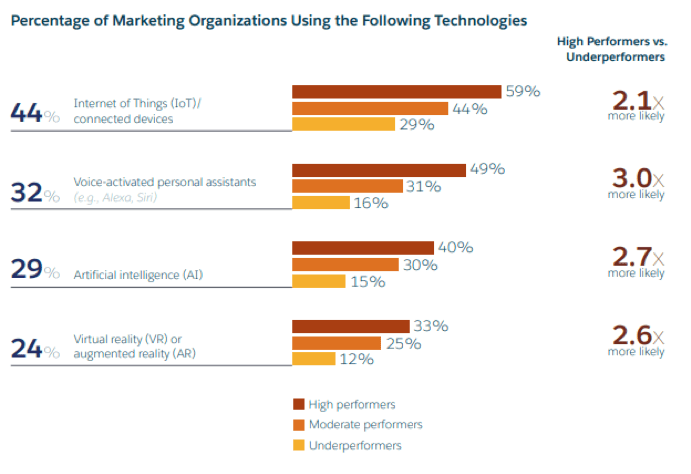
Still, AI is not the only intelligent technology that is gaining momentum. In 2018, marketers were successfully experimenting with IoT (44%), voice-activated personal assistants, like Alexa and Siri (32%), and virtual or augmented reality (29%).
These smart tools help brands deliver outstanding services and quickly win customers that are hungry for innovations. Take Sephora as an example. Their online virtual assistant perfectly recognizes face parts and allows customers to upload their personal photos to virtually try on different makeup.
6. Discover new ways of personalization
Personalization is actually a broad term. Don’t limit your opportunities by sticking to the basics only.
Let’s consider email personalization. Evergage asked companies how they tweaked emails to individual customers. The majority of respondents (76%) used customers’ or companies’ names in the subject line and the header. About 50% of companies tailored messages and provided recommendations by audience segment, or personalized email messages at send time. Less than 25% of respondents reached the granular level to tweak message content per customer or personalize messages at open time.
All these actions fall under personalization, but customers won’t feel the human touch from a mere name change in the subject line. The more seriously a company takes personalization, the more happy customers they get.
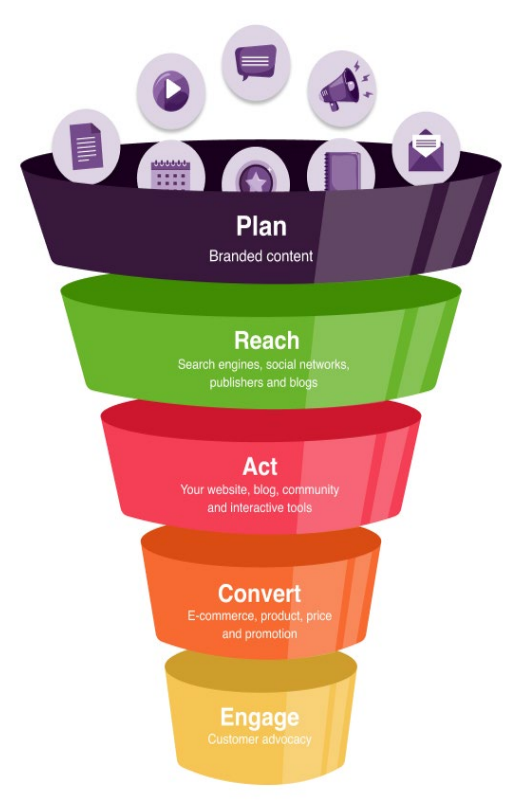
Yet email customization is not the only way to apply content personalization. Market leaders definitely go beyond this and try to deliver unique experiences at every step of their buyers’ journey.
Today, less than 30% of companies succeed in personalizing product pages, blogs, search results, navigation, and pricing (Evergage). However, the growing adoption of intelligent technologies is likely to change the situation in the near future.
Conclusion
Customers’ expectations of personalized services are getting ever more sophisticated. To make shoppers happy, brands have to adopt new technologies that allow for humanlike communication in real time.
A piece of advice to wrap this up is that personalization should be based on two-way engagement. As there can be no golden rule for every company, marketers have to analyze the results of their personalization efforts, explore customers’ feedback, and then adapt their strategies using these insights.
Maria Marinina is a Digital Marketing Manager at
Iflexion with over ten years in Marketing. Maria has a proven track record in marketing technologies, website management, analytics, and multi-channel demand generation campaigns. Currently, she is responsible for designing, managing and implementing marketing strategy. She is an experienced communicator, who excels at managing multiple projects and adjusting them based on results data.