Higher visibility into your attribution model means sales will trust the metrics more
Is your marketing team celebrating their awesome quarter while your sales team suffers poor performance? This is usually due to a sales vs marketing attribution mismatch, particularly when marketing and sales are seen as two different entities.
Ultimately this who-gets-credit-for-this-sale struggle is getting pretty old - it’s been around for as long as sales and marketing teams have collaborated together. Could it be that a data blackbox is the root of your problem?
Calculating whether a lead was sales or marketing generated can be a pretty complicated calculation, particularly in complex B2B buying cycles where multiple teams are involved. Adroll has a good example here. Due to this complexity, sales leaders tend to distrust the data given to them by marketers and fall back to pointing fingers when things don’t go in their direction.
How to use Facebook Attribution
Learn how to use Facebook’s attribution tool to make data-driven marketing decisions and set yourself apart from competitors.
Access the How to use Facebook Attribution quick win
Speaking to my friend about this, he works for a company where the calculation for marketing vs sales attribution answers the following questions:
- Was the lead created by a marketing system or manually by a sales team?
- Did someone else from the company already exist in the CRM?
- Are there any duplicates?
- What were the marketing touch-points (i.e. is it 100% sales originated)?
- Were there partners involved?
From there, the lead traverses roughly through a pipeline like the below diagram.
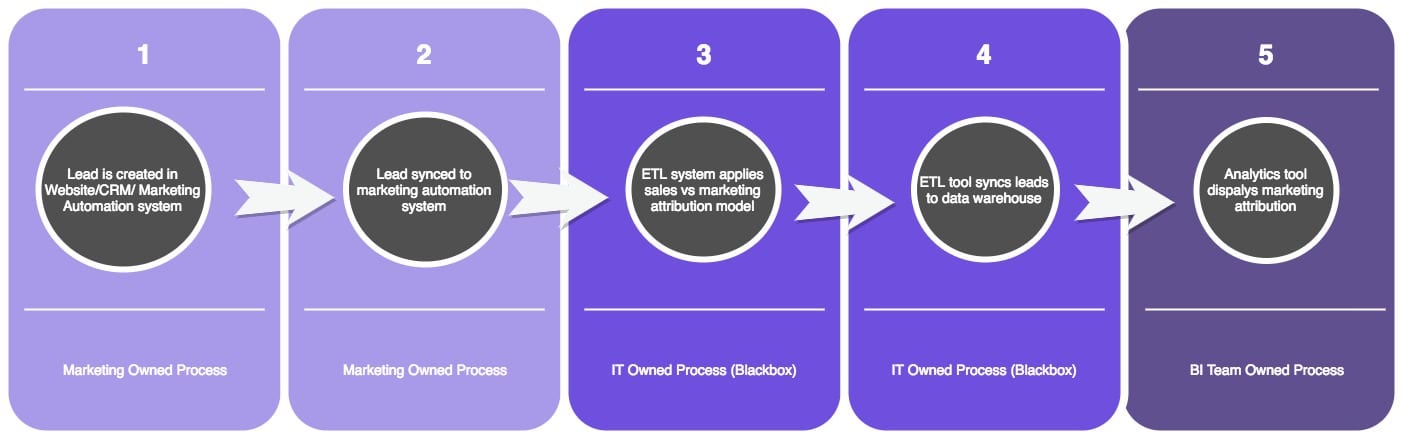
The problem with this model is the lack of visibility - the marketing team loses control and when it comes to reporting to sales - everyone is left in the dark. The middle parts of this process are a total black box for most involved. It creates mistrust and everyone starts their “own” calculations. All these steps create a game of Chinese Whispers and it’s not productive!
To avoid this fight, you can look at a more streamlined architecture for these types of calculations. Due to newer database technologies and easy to use modelling layers the reliance on several teams to come up with the calculation can become a thing of the past.
For example, tools like Segment can simplify collection of data from your marketing and sales systems, drop it directly into a warehouse and a tool like Looker can read directly from that warehouse. This essentially cuts out the middleman and brings an easy ability to trace the marketing attribution for each lead/opportunity to anyone that wants to look under the hood.
The effect of simplifying marketing attribution? A single, trustable, verifiable source of truth means marketing and sales can finally be on the same page and discussions about campaign ROI can finally be productive.

Thanks to Ernesto Ongaro for sharing their advice and opinion in this post. Ernesto is part of the Data Analyst team in
Looker, EMEA based in Dublin. Previously he has held roles in Customer Support, Pre-sales and most recently Product Marketing for Jaspersoft