Putting the right measures in place to achieve excellence in 2020
There’s little doubt that 2020 is going to be a big year for marketers (although I appreciate we say this every December!). If you’re intending to start the New Year on the right foot, it's important to be clear on what you’re looking to achieve and to gain buy-in from everyone in the business.
Whilst your marketing strategy will outline the activity you will and will not carry out over the next year, underpinning this plan will be your objectives. There are three main sets of objectives to consider:
- Business objectives, e.g.:
- Increase profit growth by x%
- Increase market share by y%
- Marketing objectives, e.g.:
- Increase sales by x%
- Increase brand recognition by y%
- Campaign objectives, e.g.:
- Increase frequency of consumption by x%
- Increase household penetration by y%
Your overarching business objectives set the tone and cascades through to the marketing and campaign objectives. Within this post, I’d like to outline a blueprint to highlight and set out the right marketing objectives for your business.
What is a marketing objective?
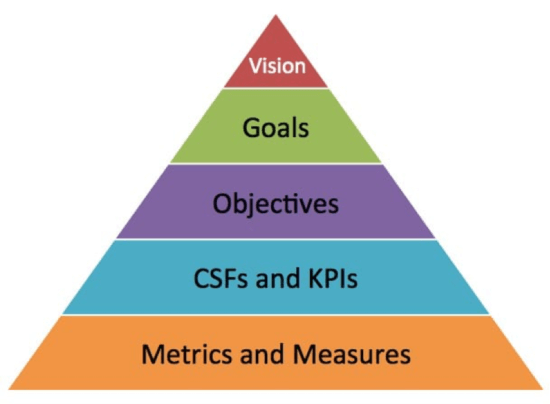
It’s worth highlighting up-front the difference between goals, objectives and KPIs, all of which may sometimes be used interchangeably:
- Marketing goals are top-level goals to show how the business can benefit from marketing activity and are used to shape your overall strategy. They describe how marketing will contribute to the business in key areas of growing sales, communicating with your audience and saving money.
- Marketing objectives give clear direction and commercial targets. Objectives are the SMART targets which can be used to track performance against target.
- Marketing Key performance indicators (KPIs) are used to check you are on track. KPIs are specific metrics that are used to track performance to make sure you are on track to meet specific objectives. They are sometimes known as performance drivers or critical success factors for this reason.
Marketing objectives give you direction and a set of results to aim towards, all of which is enabled by the overall marketing strategy. Without a clear set of marketing objectives, the team will lack focus and you will not be able to accurately measure progress based on the tactics and activity you deploy.
Review your mission statement
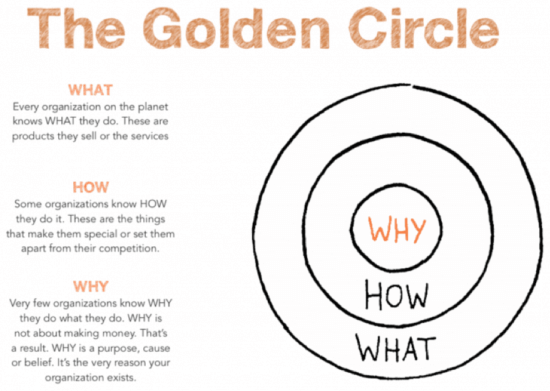
Your business vision or mission statement sets out your purpose and how you will serve your audience. A mission statement clarifies the ‘what’, ‘who’ and most importantly the ‘why’ of a company and sets the parameters for what you will focus on as part of your overall marketing plan.
Every company’s mission statement will signal what you should ultimately be doing in order to serve the customer. It’s therefore good practice to refer back to the mission statement throughout the objectives setting process to ensure that everything you’re planning to achieve fulfils the mission:
Research
Once you’ve familiarized yourself with the company's vision/ mission and strategy, research should form the foundation for your marketing objectives.
A clear understanding of the key trends and insights for the year ahead will help you prioritize the areas that are most relevant for your business. Dave Chaffey’s 6 essential marketing trends for 2020 provides a brilliant overview of how innovations in digital media, platforms and technology will shape marketing in 2020. Whilst these trends can apply to nearly any business, the key is to identify those that align most closely with your mission and strategy.
Some other useful articles and resources from Smart Insights include:
Dive into your data
The business and customer data you have should fuel the planning process and feed into the marketing objectives you’re setting for next year.
Download our Individual Member Resource – Digital marketing planning spreadsheet
The spreadsheet will enable you to create a budget for the year ahead to define and then optimise your investment in search marketing, display advertising, affiliate marketing and online PR.
Access the Digital marketing planning spreadsheet
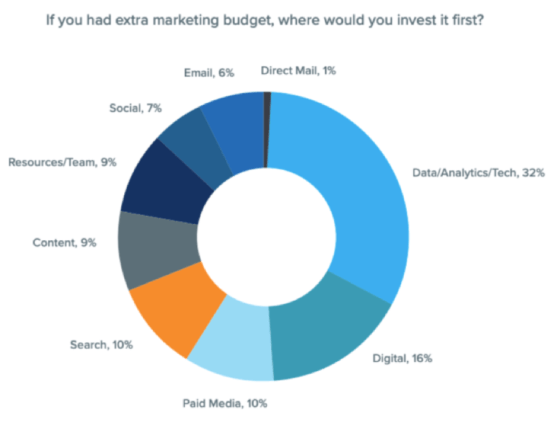
According to Merkle’s latest Customer Engagement Report, data, technology and analytics are deemed to be the most important areas at the moment, coming in ahead of digital (16%), paid media (10%) and search (10%):
Data is now an essential component of any marketing plan for a few reasons:
- Data can help you optimize across every stage of the funnel, from acquisition to customer purchase to re-engagement
- Data gives you an edge and provides you with a competitive advantage in an increasingly data-driven environment
- Data provides clarity and objectivity, giving marketers a strong voice within the boardroom
The Digital Marketing Institute provides a 5-step approach for a data-driven marketing strategy, which you can use to shape your objectives:
- Know your audience - use data, experience and research to establish a thorough understanding of your customers’ and prospects’ needs, behaviours and expectations
- Create data-driven objectives - use what you know about your audience to set clear, measurable goals
- Identify KPIs - determine how you will measure performance using key performance indicators (KPIs) before initiating any activity
- Measure performance and monitor metrics - when in doubt, collect more data than you think you’ll need
- Evaluate content and media performance. Adjust as necessary - use your data to check performance on a regular basis and always be on the lookout for false assumptions. Be prepared to make adjustments to tactics based on results
Set benchmarks
Your analysis of data and trends in the context of your business should give you the inspiration to start outlining some broad goals, e.g.:
- “We will develop a comprehensive Customer Data Platform (CDPs) to map, store, analyze and act on customer data in one place”
- “Our brand will develop a strong presence in voice search by testing and learning across a range of key platforms”
- “We will start broadening our social media footprint beyond established social platforms in order to reach our younger audience demographics”
As you begin to interrogate these goals and refine them into more specific, actionable objectives (as we’ll explore in the final section below), it will be a good opportunity to look at benchmarks and comparisons with competitors across the wider market. This will enable you to identify what you do well and opportunities for improvement.
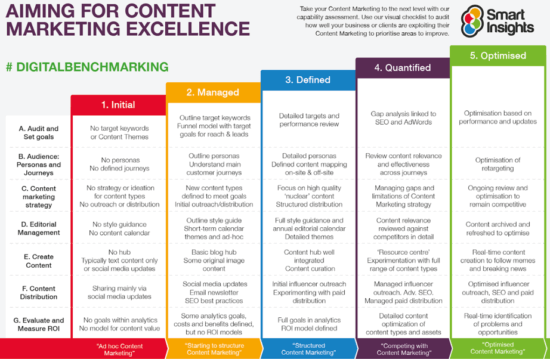
Smart Insights offers a range of digital marketing benchmarking templates to evaluate individual channels and assess overall performance. This will enable you to establish goals, objectives and plans as part of an overarching marketing strategy:
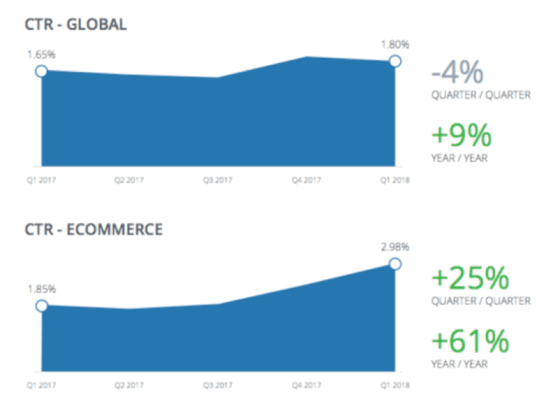
At a more granular level, you can also use data reports, such as this one on average display advertising clickthrough rates, to compare your own performance and look at areas for growth and improvement:
Recent changes in Facebook CTRs from a Nanigans Q1 2018 Facebook advertising benchmarks show response rates moving upward for e-commerce marketers even after increasing in Q4. The average Q1 2018 CTR of 2.98% in Q1 is 25% higher quarter-over-quarter and 61% higher year-over-year. This is at a similar cost of $10.24 CPM, a quarterly decrease of 2%. Average CPCs are $0.34 in retail:
Be SMART
When setting future objectives for marketing it’s useful to look hard at each measure and ask “is it essential?”. One of the enduring golden rules of objective-setting is to, therefore, ensure that anything you commit to is SMART. This acts as a test or filter that can be used to assess the quality of measures:
- Specific – can the detail in the information sufficient to pinpoint problems or opportunities? Is the objective sufficiently detailed to measure real-world problems and opportunities?
- Measurable – can a quantitative or qualitative attribute be applied to create a metric?
- Actionable – can the information be used to improve performance? If the objective doesn’t change behaviour in staff to help them improve performance, there is little point in it!
- Relevant – can the information be applied to the specific problem faced by the marketer?
- Time-bound – can objectives be set for different time periods as targets to review against?
Some useful examples of SMART objectives include:
- Digital channel contribution objective. Achieve 10% online revenue contribution within two years.
- Acquisition objective. Acquire 50,000 new online customers this financial year at an average cost per acquisition (CPA) of £30 with an average profitability of £5.
- Conversion objective. Increase the average order value of online sales to £42 per customer.
- Engagement objective. Increase active customers purchasing at least once a quarter to 300,000 in a market (a hurdle rate metric).
For more information on SMART objectives, check out Dave Chaffey’s comprehensive overview of the SMART objective process from October this year.
Conclusion
Whether your marketing strategy is already in place or going through a period of change, the objectives you set can flex to reflect the internal and external changes impacting the business. With 2020 on the horizon, now is a perfect opportunity to reflect not only on your overall strategy but the specific objectives that will underpin the activity you choose to undertake in the year ahead.
A marketing objective should give clear direction and provide SMART targets that the whole team can rally behind and be used to track performance. To get to this point, a combination of research, reflection and benchmarking against the wider market will help inform what you should be aiming for and why. Smart Insights provides a wealth of insight, guidance and best practice across all of these areas so be sure to check out these resources today!