How the 4Ps still work for product marketing
This article focuses in on the 4Ps, which are the core of the Marketing mix, applied to the product launch. Read our article on the 7Ps of the Marketing mix, if you want to explore the full 7Ps, which also includes customer service.
Download Premium Resource – Product launch Playbook
Launch a product using RACE planning to structure your marketing activities. A marketing playbook defines the key messages, types of communications, best practices and optimisation techniques that should be used to maximise return-on-investment for different marketing objectives.
Access the Product launch playbook
Some have said that ‘the Internet and digital marketing change everything’, but the marketing mix – widely referred to as the 4Ps of Product, Price, Place and Promotion – was originally proposed by Jerome McCarthy in 1960 as explained in the Smart Insights free guide to Marketing models and frameworks and is still used as an essential part of formulating and implementing marketing strategy by many practitioners.
I’ll cover them in the order of Product, Price, Place, and Promotion since that’s how I remember it and it’s a logical order to cover creating a plan.
Product
We start with product since that’s what we’re launching. The product variable of the marketing mix refers to characteristics of a product, service or brand. Product decisions should be informed by market research where customers’ needs are assessed and the feedback is used to modify existing products or develop new products. There are many alternatives for varying the product in the online context when a company is developing its online strategy.
So, to keep our product launch customer-centered we have to consider audience too.
Understanding your audience:
- Your audience should have been considered as part of the new product development process. As part of the launch campaign, it’s worth revisiting this and considering the factors that will affect the buying decision. If you don’t have personas summarising your audience, you should create buyer personas to help tailor your message to the audience.
This should happen at an early stage in new product development. It’s fundamental to understand who your product is for and how it will appeal to them. The earlier you define this the better, since your launch communications plan needs to define key persuasive messages for your audiences to encourage them to buy the product.
Here are five factors to consider about new online product buyers:
- Digital product buyers REALLY understand how the web works. They demand product content that delivers PERSONAL value – quickly.
- When it comes to online, buyers rule. Your new product marketing should be highly tailored, featuring esteem-driven messages.
- Branding is king but ‘comparison’ governs. Today’s consumer instantly compares competing brands – irrespective of size of company or heritage. Therefore, ensure your brand are values are clear and reflected throughout your content.
- Buyers talk. From blogs to Tweets, forums to ranking sites, users love the power of the web. It lets them vent anger or bestow praise on products. Harvest the positive comments –and you have a powerful community supporting your marketing. Address valid negative comments, and you demonstrate authenticity and care plus you can adjust the product or message accordingly. The key is to success is to continuously manage expectations and hone your message.
- Users become buyers in stages. Before writing emails or building product sites, think about the entire customer journey:
How do people typically make purchase decisions in your space? Over what length of time?
What assurances can you offer before expecting them to buy? These should be delivered at different points in the buying process.
Specifically, what do they need to know before they reach that point?
Understand your personas by building conversations which match your target audience’s journey towards eventually buying your product.
Will it sell?
From a marketing perspective, the most pressing product question is simply will your new product sell? Success calls for the right choice of online channels providing the appropriate platform to explain your product’s points of differences (as opposed to unique selling points).
These points of differences include: what kind of add-ons or downloadable services are available to keep a product fresh and relevant (until an entirely new iteration of a product needs to be introduced. Or how a product (such as a new kind of photo manipulation software) is saved and the storage implications to customers. For example, how much space each photo-project takes up on mobile devices, whether the projects are displayed pictorially or otherwise? Can projects be easily curated according to genre, date… and so on… Each variant holds the promise of being another point of difference that sets your new product apart.
The importance of brand identity and development
Without a strong brand presence, your product can feel indistinctive. An online brand is imbued with character and personality – both of which need to be reflected throughout your digital strategy.
Whilst features and benefits explain WHAT a product is and does, a brand offers a sense of ‘WHO’ it is. Such humanizing of product enforces emotional connections which in turn gives even a simple product a discernible personality, or makes a complicated product more accessible, pertinent and understandable.
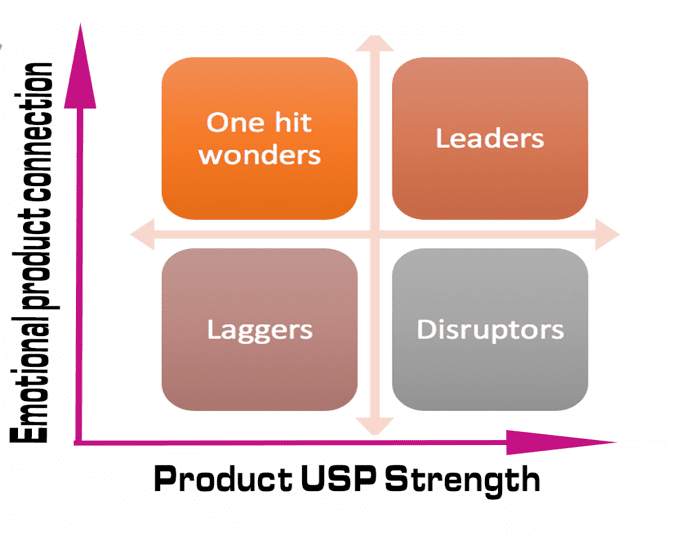
The frailer your emotional product connection, the greater the need to promote its points of differences (traditionally – USPs) and conversely, the stronger the emotional connection, the less the urgency to highlight product points of differences or USPs.
Having established the ‘WHO’ behind the product, keep checking that your personality remains consistent. (Nobody trusts unstable personalities). Brand solidity can be expressed via colours, shapes, tone of voice, styling, corporate philosophy, and so on. When considering the brand personality for your launch, think beyond simply describing your product. For example, GoPro camera could easily describe themselves as a compact mobile video recorders. Instead, the brand describes itself as “an experience sharing company.”
Pricing
Thanks to the web, the biggest shop window in history fits as comfortably in a pocket it does on a large screen. Increasingly, in many categories, before every other consideration such as online reviews, product quality and brand value has been taken fully into account - buying often boils down to price. Depending on pricing levels, it may be worth testing whether you show a pricing matrix or not.
Whether it is via official price comparison sites, or casual ‘live’ price checking of different product suppliers, digital opens opportunities for a myriad of marketing pricing tools. For example, product introduction email campaigns can feature voucher codes or cashback offers.
In exchange for paying a commission fee, affiliate marketing partnerships open opportunities to market products via third-party websites. Commissions needn’t just be conditional on sales. Arrangements can be agreed for payments triggered by click-throughs or other actions.
It is often argued that selling online is cheaper for suppliers than via traditional high-street retailing. However, once a product has been added to site’s shopping cart, distribution can be expensive – especially when consumers expect delivery to be included in the price. Buyers also expect that your product can be bought via all major credit cards, PayPal as well as Android or Apple payments.
Online or offline, it is still cheaper to retain an existing customer than recruit a new one. Yet, unless behaviours are ingrained (such as buying books on Amazon) online customers tend to be particularly capricious. Consequently, any strategy regarding a product launch needs to consider issues such as future customer relationship management and lifelong value.
Place
In the bricks and mortar world, ‘location, location, location’ is everything. Typically, for offline channels, the aim of Place is to maximise the reach of distribution to achieve widespread availability of products while minimising the costs of inventory, transport, and storage. In an online context, thanks to the ease of navigating from one site to another, the scope of Place is less clear since Place also relates to Promotion and Partnerships. Online, for a retail page, it’s about page, picture, and parcel. You need to have the right stock levels. Customers are online – but is your product in-stock?
- Page: Is your website accessible? Has it been optimised? Is the content coherent and helpful? For example, do you offer Live Chat to handle customer questions?
- Picture: Is your product fully discoverable using tools like 306° pictures or video?
- Parcel: Can your product be dispatched quickly and efficiently (either direct from you or via a partner?) More broadly it links to promotion techniques like affiliate marketing or co-marketing.
Promotion
Many startups launching new products may be short on funds for paid promotion, so choosing when and how to invest is a difficult decision. Let’s quickly review the options as I see them:
- Organic search (SEO) – offers free/low-cost traffic, but takes time to get traction unless your product launch is part of an existing site with domain authority
- Paid search (Google AdWords) – while this will be too expensive for many startups due to competition and bid inflation, it’s worth looking at the cost of AdWords Remarketing. This is usually more cost-effective and you can use reminder ads to encourage people to return to your site ton boost conversion.
- Organic social – this will be a core technique for many startups as they will be keen to build a community and gain advocacy
- Paid social – a similar argument applies to AdWords. Re-targeting through social ads has relatively high ROI.
- Public Relations – This can be a low-cost approach, but only if you have the media contacts and know how to run an outreach programme.
- Affiliate marketing – Affiliate marketing is mainly relevant to retail or subscription products. It’s value in product launches is limited since affiliates are interested in the number of clicks out from their sites and earnings per click, so they are likely to want to keep with trusted, established brands that drive volume.
For search, I recommend creating a search demand analysis. Decide how you will target audiences needs by using Google Keyword Planner to calculate the number of visits based on search volumes for different keywords. A spreadsheet for gap or demand analysis which also helps compare actual visits post-launch against numbers of searches.
Download Premium Resource – Product launch Playbook
Launch a product using RACE planning to structure your marketing activities. A marketing playbook defines the key messages, types of communications, best practices and optimisation techniques that should be used to maximise return-on-investment for different marketing objectives.
Access the Product launch playbook