Is there a growing disconnect between a brand and its digital marketing strategy?
Failing to adjust and implement a clearly defined digital strategy could be due to the disconnect between a brand, its purpose and the digital tactics used to meet company objectives.
With the brand’s purpose not clearly understood and integrated within the journey through the digital transformation, brands may be finding themselves lost. This leaves their digital operations and tactics isolated, being operated and managed in a silo.
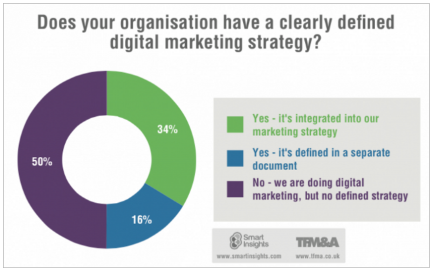
This growing disconnect between the brand and its digital marketing strategy was highlighted in a recent survey by Smart Insights who asked the question:
“Does your organisation have a clearly defined digital marketing strategy?”
For organisations to suggest digital is either a separate strategy or none at all, really does ask the question: have brands themselves become disconnected from their (digital) future?
There are three key important factors that are playing out:
The acceleration and need to stay relevant has meant many brands have not kept apace with a changing business landscape, disconnecting themselves from the tactics now used to help service their growing numbers of “digital” customers
There are growing expectations to deliver new and innovative revenue streams through digital channels as budgets continue to shift from offline to online channels
Specialist skill sets: Brands try to retain their relevancy and to keep pace with a digital landscape, so they hire specialist digital marketers to work on specific channels. But these are not necessarily connected with the brand purpose
The issue is not the impact and opportunity digital technology and culture can provide, more the fact that digital needs to be moved to the centre of the organisational structure, to not be treated as a siloed strategy, to provide the opportunity to connect to the purpose ofwhy the brand exists.
Brian Solis, principal analyst of Altimeter has released a report entitled, The 6 Stages of Digital Transformation suggests the opportunity for success can only be done by listening, interacting and building relationships with your users, your customers and knowing your purpose, why you exist as a brand….
“Companies need to focus on becoming more Innovative and Adaptive a point in the process where digital is no longer a silo but is how the business operates, in the DNA of its operation…By that it is involving the brand, the purpose and personal traits it promotes to the external environment”.
Not Knowing your Why
Which brings me onto the issue for brands who do not know their why.
Author Simon Sinek suggests brands should be asking: “People don’t buy what you do, they buy why you do it”, this video is worth watching from his recent TED talk
Every single brand knows what they do, and some know how they do it, but few brands know why they do it — in other words what is their purpose?
This why, how and what forms the golden circle as described by Sinek. However, the issue is most brands start from the outside in for example, what they do and how they do it .
Working from the outside in
Applying the golden circle may be an indicator as to why digital strategy is disconnected from the brand and its purpose and why in many cases being driven by data alone is a reason for the disconnect and the growing gap between a brands purpose and the digital tactics applied.
Red Associates, an innovation and strategy consultancy promote the need for more time and resource given to thick data, that is data generated by ethnographers and anthropoligists that focus on human behaviours more.
A lot of time spent is on the big data, the analytics insights, the insights that perhaps provide short term gain whilst at the same time not thinking about the actual users, the customers and the purpose of what you as a brand are providing users.
Rather than data modelling alone, organisations need to be blending big data with thick data, so that you can generate qualitative insights to help provide a deeper understanding of the brand and its purpose.
The Age of the Customer
Marketing has evolved and has digital has helped accelerate the ways in which brands entertain and educate their users, we’ve entered the age of the customer, where customers have more information, choices, and power than ever before. The customer experience — the culmination of all brand and customer interactions — now matters more than anything.
The use of thick data is becoming even more essential as we move to the age of the customer, a phrase coined by Forrester and supports the growing movement of “empowered customers shaping business strategy. Customers expect high value digital experiences and will go elsewhere to a competitor if you can’t service and meet their requirements”.
Brands should not be treating their digital strategy as a mix of tactics (e.g. search, social media, content marketing, etc).
Instead, think of digital as a part of the lifeblood of the organisation. According to Hubspot, 71% of marketers were creating more content than in 2014, but according to the chart above there seems to be a disconnect between why this content is being created and for what purpose?
We are obsessed by what is new and what new channels and tactics to jump head first into and this can be a huge distraction when there is not clearly defined strategy or not clear on your brands purpose
By Simon Swan
Explore RACE
Strengthen your strategy with RACE-powered templates, frameworks and planning tools designed to help you review performance, identify improvements and build a more effective marketing approach.