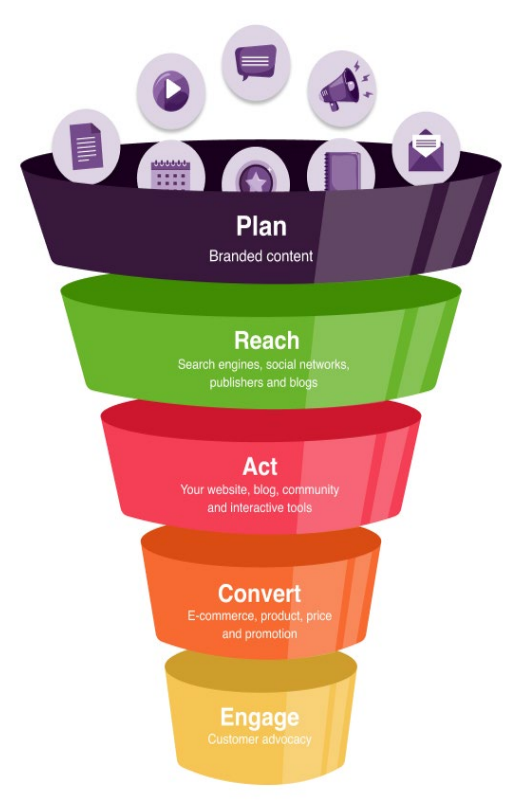
B2B content marketing strategy for traditional and inbound marketing
The B2B buying cycle is a long, arduous process. It includes multiple stakeholders with different agendas and an aversion to risk lingering from the last decade’s financial difficulties. Couple the aversion to risk with the new trend of buyers researching extensively before contacting the seller and you get today’s B2B selling environment. It demands a change in strategy from your marketing and sales teams.
Inbound marketing, a method of “pull” marketing, replaces traditional marketing's practice of appealing to the broadest possible audience in the hopes of capturing a single sale. Inbound marketing is more effective and substantially less costly than traditional marketing, and it meshes with new buying trends.
Inbound Marketing: The Definition
Inbound marketing leverages content marketing, email marketing, and marketing automation to build rapport and trust. Sellers nurture a relationship with prospects by offering valuable content that answers the most pressing questions from a specific target audience. Sales and marketing must work closely together to achieve the best results.
The objective of inbound is to attract potential buyers to your solution early in the buyer journey without “selling” to them. Instead, you tailor highly relevant content to your ideal buyer and continue to provide additional information during the lead nurturing and qualification process. You earn the attention of your potential customers rather than demand it.
- No selling or overt promotion.
- Don’t talk about yourself, talk about solutions to the prospect’s pain points.
- Inbound is not the same as advertising.
Inbound marketing lets you keep the momentum of the sale going. Its effectiveness is the result of your deep understanding of your audience that informs the relevance of your content.
The Benefits of Inbound Marketing
Inbound marketing is better than traditional outbound marketing and cold calling. Period. Companies that use inbound techniques generate three times the number of leads at 62% lower cost.
- A well-designed inbound campaign provides measurable, repeatable results.
- You obtain more qualified leads that are closer to the end of the sales cycle.
- You have many fewer unqualified leads for sales to waste time on.
Marketing automation easily tracks a variety of metrics that tell you how well your content is performing. Because it is so simple to set up and make changes to an online campaign, you can perform A/B testing; publish two different versions of almost any content to see which generates more leads and results in more sales.
Inbound marketing fits with the online research trend that has been growing for years. Over 70% of B2B buyers begin gathering information on their problem and potential solutions through general internet research. Their research may be 90% complete before they ever contact you. To build awareness, you need to generate content for them to find.
More advantages:
- You have continuous lead generation to your website.
- You receive insight into the ROI of your marketing budget.
- You can optimize your lead acquisition based on data.
- You learn more about your leads during their buyer’s journey.
In 2012, the average cost per lead for traditional marketing was $346 while the average cost per lead for inbound was $135, an impressive reduction that may be even larger now.
Inbound marketing increases your visibility online through the power of SEO and keyword research tied to your content. When you regularly publish new content, your search engine ranking improves even faster and you are found more easily and more often by prospective buyers.
It’s All About the Funnel
Inbound marketing uses the sales funnel to segment prospects and provide the right content. The buyer’s journey through the funnel is typically broken into three segments:
- Top of Funnel - TOFU
- Middle of Funnel - MOFU
- Bottom of Funnel - BOFU
Different types of content work best for each segment. For example, at the top of the funnel (TOFU) these types of free content work best:
- Blog posts
- Infographics
- Social posting
- Short videos
- Website pages
During their journey through the top of the funnel, you may begin gathering a small amount of information from prospects, enough to allow you to begin a nurturing campaign through email.
As they receive your nurturing sequence emails, you can begin to provide premium content in exchange for more information to help you understand the prospect’s business and pain points. Content for the middle of the funnel (MOFU) provides value. Prospects at this stage are willing to trade information to obtain:
- Ebooks
- White papers
- Case studies
- Webinars
As prospects reach the bottom of the funnel (BOFU), they have defined their problem and identified a short list of solutions. At this point, you want to provide content that verifies their choice. They need product specific information that overcomes any objections and helps them reach a decision.
- Testimonials
- Free trials
- Demos
- Product videos
- Competitor matrices
On the way through the funnel, you have gone from providing thought leadership and educational content to more specific content that helps prospects define their problems and educates them on potential solutions. Finally, you get the chance to “sell” and promote your offering as the best solution for their problems.
Getting Started with Inbound Marketing
Are you ready to do some inbound marketing?
- Determine what questions your content needs to answer and develop a buyer persona, which is a well-researched example of your ideal customer.
- Perform an audit of your existing content and identify any gaps.
- Develop content to fill the gaps and repurpose old content in new ways.
- Determine the best social media networks to share your content.
- Identify the proper metrics to measure how well your content performs.
Content can come from anywhere.
Put several related blog posts together into an ebook. Create a webinar or video out of a white paper. If you have a page of FAQs, write a blog post or produce a podcast for each to provide a deeper answer.
Each piece of content can be shared on social media and premium content placed behind a form. Create a landing page and link to it from your social media accounts or nurturing emails to give your prospect a chance to give you more information.
Use an analytics suite like Google Analytics to monitor and track the performance of your content and website. Use the results to fine-tune the content and measure the ROI on your marketing budget.
There is over a decade of statistics and evidence substantiating inbound marketing’s outperformance of traditional marketing. Inbound costs less, is more effective, reduces your time to close, and provides metrics to show you how well you spent your money.
The question isn’t “Why would your B2B company implement inbound marketing?”
The question is: “Why wouldn’t you?”
Thanks to Nicole Letendre for sharing their advice and opinion in this post. Nicole is Marketing co-ordinator for Bonafide, a digital marketing agency in Houston, Texas. She loves writing, social media and keeping up with the latest marketing trends.