What sets apart those digital marketing strategies that you read about in case studies, from those failing strategies that never see the light of day?
Aside from the impact that budgeting and available resources will have on the outcome of any strategy, there are some steadfast rules you can stick to, to give your digital marketing strategy the best chance of success.
"What's the use of running if you are not on the right road?"
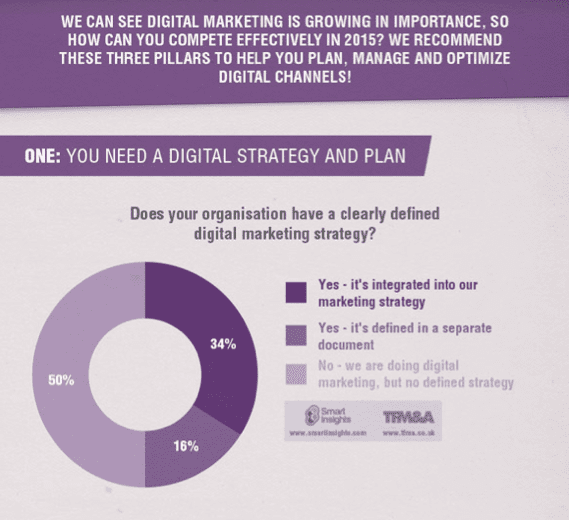
There’s a German proverb that says “what’s the use of running if you are not on the right road?” and needless to say I was shocked to discover from an infographic by Smart Insights and TFM&A that many marketers set out without so much as a digital marketing strategy!
Digital marketing case studies
Learn from brands who have successfully transformed their marketing across a variety of industries with our pack of digital marketing case studies.
Access the Digital marketing case studies
Digital Marketing Strategy Tip 1: Stay Agile
Conversely, traditional offline marketing strategy can typically be planned for up to 5 years in advance. Whilst you want to keep a long term goal and strategy in mind, breaking this plan down into tactics and smaller goals for six month or quarterly periods works well in the digital landscape. Anyone who’s ever done a SWOT or PESTLE will know that consideration of the external environment is crucial for business planning as a whole and marketing specifically (look at what ignoring developments in technology did to Blockbuster).
A brief look at Google’s recent algorithm updates will show that even in the last year or so there have been changes in how websites are ranked in search engines.
Social media is consistently changing too with new social media platforms on the scene and big updates to existing platforms like Twitter happening on a near monthly basis (like the quote tweet function and the launch of Moments).
Change marches on in the world of paid search too. With AdWords always releasing new functionality and tools, the ways to use paid search to reach your audience are always improving and changing.
For digital marketing strategies planning for 6 months or quarterly is a good way to ensure that you can stay agile and ready to take advantage of the next opportunity or steer clear of problems as technology and consumer behaviour online develops.
Digital Marketing Strategy Tip 2: Regularly Analyse Competitors
You might think, why do I need to worry about what other people are doing? But in business, if you’re not monitoring your competitors you’re missing a big opportunity. Your competitors may suck, but they might just be doing one thing that could be useful for you. The things your competitors are doing wrong can also give good insight into your digital marketing strategy.
It’s None of Your Business!
There’s lots of ways to do some competitor analysis, depending on what digital marketing channels are your most important. Sign up for their emails, monitor their domains and keywords, track what offers they are running.
Of course you shouldn’t start stirring the pot with underhand tactics like clicking on their PPC ads. You don’t need to intervene in their marketing activities to study them and even something as simple as having a good look around at the layout and content of competitor websites’ can give you some great ideas.
Keeping an eye on your competitors minimises the risk that they’ll catch up and overtake you and stops you resting on your strategic laurels.
Digital Marketing Strategy Tip 3: Measure Key Benchmarks
Not setting KPIs at the start of a campaign is setting your digital marketing efforts up to fail before they even start. To truly understand the campaign you must of course, first measure benchmarks.
The Measure of Success

Unlike much offline marketing there are real opportunities to effectively measure KPIs which directly correlate to marketing activities using the data available online. By putting a little code here and there, Google Analytics opens up a whole world of data at your fingertips.
When Google Analytics is set up you can spend a long time in there sifting through data to get insights as in-depth as you’re prepared to search for. Exploring traffic, conversions and audience data to build up a picture of the current and historical marketing situation to see what effect different campaigns had.
Looking in Google Analytics can make you feel like a real sleuth and with some lateral thinking and a bit of time you can build up some great insights around your marketing efforts and how people are engaging with your website. For example, are some of your top landing pages, the ones you recently optimised with new keyword rich content and meta data?
Benchmark KPIs like traffic, conversion and sales before you start digital marketing campaigns and revisit the metrics during campaigns to feed this information back into the strategy. Then finally measuring these metrics more comprehensively at quarterly and six months periods to have a thorough review of the campaign before planning ahead!
Key Takeaways
- Do your research! Competitors, market landscape and audience research will all be invaluable in helping guide your digital marketing strategy.
- Plan agile digital marketing strategies whilst keeping in mind the long term goal.
- Break your strategy down into tactics and make the magic happen!
- Measure success at regular intervals and feed back into the strategy to adjust before failure strikes.
- Evaluate what’s worked and what hasn’t and then start again!

Olivia Collins is Digital Marketing Executive at Digital Marketing Agency
ThoughtShift, an award-winning agency specialising in increasing eCommerce SEO and PPC sales. Olivia writes regularly on the latest trends in digital marketing and consumer behaviour online. Follow ThoughtShift on
Twitter for
LinkedIn for bite sized digital marketing tips.