Unless you have been marooned on a desert island, chances are you know what Artificial Intelligence (AI) is and have experienced the benefits of machine learning is having on customer experience and business operations
Despite being around for decades, AI is currently one of the most popular topics in business with Gartner predicting that by 2020 AI will be a top five investment priority for more than 20% of CIOs.
Join Joey Moore, Director of Product Marketing and Greg Moore, Manager for Personalisation and Campaign Strategy of Episerver for a practical webinar on The 3 key ways to improve the customer journey.
AI is currently closing the gap between detecting patterns from large data sets and predicting intent (a role traditionally reserved for human marketers and merchandizers). AI-powered technologies are replacing the manual work traditionally completed by merchandizers to make product recommendations and marketers to make ad spend decisions. For now, AI will not completely replace all human effort, but it will dramatically improve the effectiveness of ecommerce teams that use it while enhancing the experience of shoppers who purchase from AI-centered ecommerce businesses.
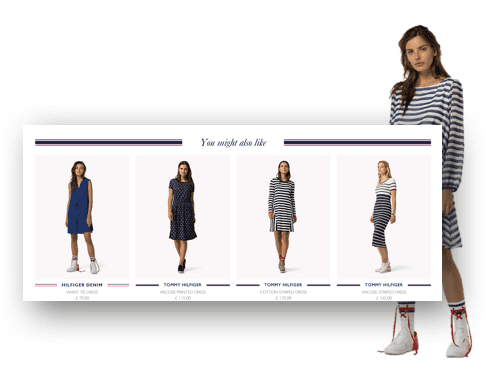
Today, AI enhances the shopper’s experience by delivering personalized product recommendations
The primary way AI has taken the online world by storm is by delivering highly personalized experiences shoppers desire. Using AI to personalize the customer journey is a huge value-add, and those that have implemented personalization strategies see sales gains of 6-10%, a rate two to three times faster than other retailers, according to a report by Boston Consulting Group.
Many ecommerce websites use AI-powered product recommendations engines to target and personalize which products are displayed to customers. A variety of machine learning algorithms have been developed by technology vendors (including Episerver) that alter the recommendations based on the stage or channel a customer is shopping in. For example, algorithms that prioritize top selling products may be used on a product details page while algorithms that prioritize complimentary products may be used on the cart and checkout pages.
2018: Ubiquitous personalization, voice & chatbots, and the introduction of predictive analytics
1. Ubiquitous and automated personalization using machine learning algorithms
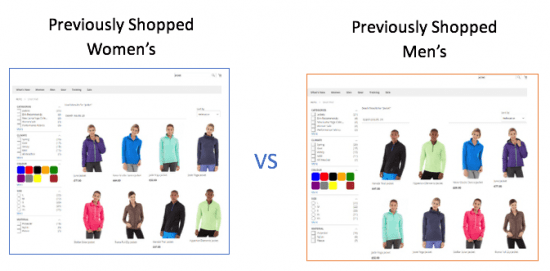
AI-powered personalization tools are now extending into new stages in the customer journey such as personalizing search results on ecommerce websites to each individual shopper and injecting personalized product recommendations into new digital touchpoints such as shoppable mirrors. Personalized site search tools like Episerver’s Personalized Find automatically change the sort-order of product searches based on the behavior of the user who is conducting the search, which has the potential to dramatically improve relevancy of search results and lead to higher conversion.
2. Voice commerce and chatbots powered by natural language processing
But the most transformative AI-powered tools we will experience as consumers will use natural language processing (NLP) to understand and respond to voice and live chat interactions. NLP chatbots can be embedded and used through major messaging applications to act as customer service agents without needing a human. Chatbots make it easy and fast for customers to reach retail businesses using the same messaging services they use daily.
NLP voice commerce tools and virtual personal assistants (VPAs) will also transform how consumers interact with ecommerce websites, by allowing them to search and purchase using voice commands in scenarios where a customer doesn’t have a touchscreen or computer. In fact, by 2020, Garter Research predicts end-user spending on VPA speakers will reach $2.1 billion, growing at a compound annual growth rate of 43% from 2015 through 2020, while by 2018, 30% of our interactions with technology will be through “conversations”.
3. AI will empower marketers to make better decisions with predictive analytics
While AI has and will continue to transform how we shop online, the most revolutionary changes to ecommerce will be how online retailers and B2B companies analyze customer journeys and make marketing and merchandizing decisions. Predictive analytics will allow AI to take over discernment and prediction historically reserved for human judgment.
Predictive analytics uses pattern recognition technology to process and detect patterns in large amounts of data, often so large and diverse that many marketers and merchandizers would overlook them. Once AI can detect these patterns, AI programs can be taught to display these findings to merchandizers to act upon. This is called next best action. There are three scenarios emerging for ecommerce teams big and small to take advantage of when it comes to predictive analytics:
- Propensity to purchase: As ecommerce leaders, we would love to know who wants to buy something and when they want to buy it. One example use case allows a marketer to see how many digital interactions such as page views or emails sent before a stagnant customer segment will reactivate and make a purchase. Next best action will allow marketers to create a segment of customers approaching the purchase threshold to offer a targeted promotion.
- Product sales analysis: Ecommerce leaders would also love to know which products are going to be popular if they are put on sale and which products are probably going to be sold with or without discounting. Predictive analytics can analyze previous sales data to allow a merchandizer to see what products are likely to sell next month if they are put on sale.
- Integrated digital marketing analysis: The famous and accurate statement by John Wanamaker, “Half the money I spend on advertising is wasted; the trouble is I don't know which half” is even more relevant in a digital age than in the early 1900’s when Wanamaker was operating retail stores. Predictive analytics will allow marketers to see what customer journeys are leading to conversions and which ones are wasting money precious advertising dollars and resources.
In 2018, data will be the new currency
The technology that enables this level of analytics requires a centralized repository of all customer data including browsing behavior and purchases. In the emerging field of AI-powered ecommerce, data is the new currency. Ecommerce departments must centralize their customer and order data and enrich this data profile by integrating their marketing, ecommerce, and back-office technologies together. Some companies are years into these initiatives but most have not even begun. Episerver is piloting a Customer Data Management platform which will enable marketers and merchandizers to run predictive analytics use cases like the ones described above.
AI will be a game changer
Advances in artificial intelligence have changed our lives and the impact of AI in retail and ecommerce is undoubtedly picking up speed. AI is starting to have a significant effect on the way ecommerce businesses attract and retain customers. A survey by Gartner predicts that by 2020, 85% of a client’s relationship with a business will be managed without interacting with any human. While ecommerce giants like Amazon, Walmart, and eBay have used these capabilities behind the scenes for years, more modest ecommerce teams can do the same, dramatically improving the effectiveness of the teams that use AI while enhancing the experience of shoppers who purchase from these businesses. AI is becoming more and more sophisticated by the day. And ecommerce businesses are now able to harness that power to improve consumers’ shopping experience.
Smart Insights are holding their fourth digital marketing Summit on the 12th December, where they will explore the key digital trends for 2018. Join Joey Moore, Director of Product Marketing and Greg Moore, Manager for Personalisation and Campaign Strategy of Episerver for a practical webinar on The 3 key ways to improve the customer journey.
In this webinar, you will learn the value of personalization to businesses. We show you how it can improve your customer's online experience by giving them an individualized journey resulting in improved satisfaction, increase loyalty and ultimately more profit to your business.
We will walk you through the 3 key ways and show real-life examples for each:
The importance and convergence of Analytics and Machine Learning
The three tiers of personalization - Basic, Segmentation, and Behavioural
How you can implement your personalization strategy by using:
- Personalized Search Results
- 1:1 Individualised Email Marketing
- Content Personalisation
Sign up for your FREE place today!
Thanks to Edward Kennedy, Commerce Strategist at
Episerver for sharing their advice and opinion in this post. Episerver connects digital commerce and digital marketing to help organisations create unique digital experiences for their customers, with measurable business results. You can follow Episerver on
Twitter.