Agentic Engine Optimization: Why Your Content Strategy Needs Both Human and AI Readers in 2026
Google’s AI director reveals token limits and front-loading strategies. Learn how to optimize content for both human engagement and AI agent parsing…
You will know that in most consumer marketing sectors, in most countries, we're well past the mobile tipping point where mobile web usage is more important than desktop measured by number of site visits.
Another way of looking at the importance of mobile is looking at the mobile share of digital minutes. This is measured by the large, international panel providers like comScore and in their latest report on Mobile’s Hierarchy of Needs they have a report that shows the importance of mobile in all countries.
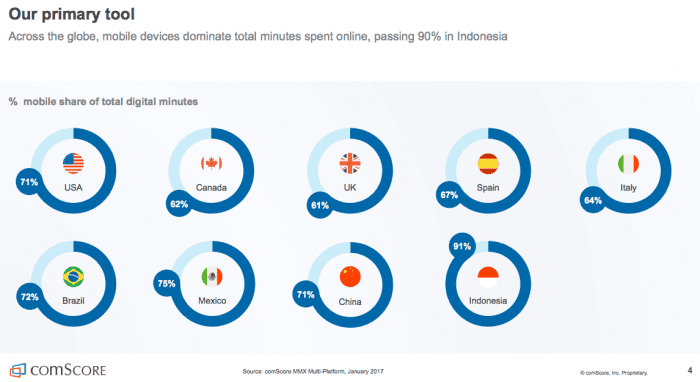
So it's no longer a case of asking whether mobile marketing important, we know it is! It's now a question of using the statistics to understand how consumers behave when using different types of mobile devices, often alongside larger format devices and what their preferences are.
Many, I'm looking at you here Google, have used statistics like these to promote a fanatical 'mobile First' agenda, but this is misleading as another chart in this report shows:
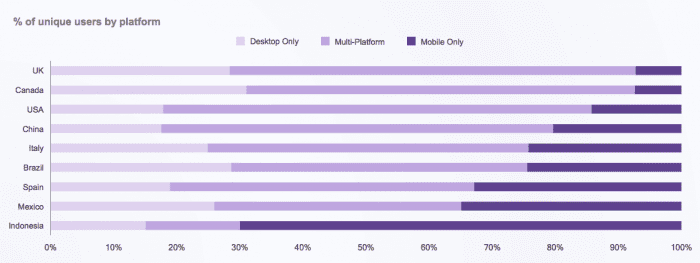
Here you can see that in most countries multiplatform ownership dominates, so we switch between mobile and desktop, particularly when selecting products and services. Many of the mobile minutes come from social media, video and mail app usage (in all these countries the percentage of mobile minutes spent on apps is 80-90%), but when we select products we will still often turn to desktop to take the decision, particularly for high involvement decisions like travel and financial services. So comScore's message, which I agree with, is to consider communications tactics for the multi-platform majority, except in the case of very young or old demographics which tend to mainly use mobile or desktop respectively
By Dave Chaffey
Digital strategist Dr Dave Chaffey is co-founder of Smart Insights and creator of the Smart Insights RACE Planning Framework. 'Dr Dave' is known for his strategic, but practical, data-driven advice. He has trained and consulted with many business of all sizes in most sectors. These include large international B2B and B2C brands including 3M, BP, Barclaycard, Dell, Confused.com, HSBC, Mercedes-Benz, Microsoft, M&G Investment, Rentokil Initial, O2, Royal Canin (Mars Group) plus many smaller businesses. Dave has contributed his expertise to many of the templates, guides and courses in our digital marketing resource library used by our Business members to plan, manage and optimize their marketing. Free members can access our free sample templates here. Dave is also keynote speaker, trainer and consultant who is author of 5 bestselling books on digital marketing including Digital Marketing Excellence and Digital Marketing: Strategy, Implementation and Practice. In 2004 he was recognized by the Chartered Institute of Marketing as one of 50 marketing ‘gurus’ worldwide who have helped shape the future of marketing. His personal site, DaveChaffey.com, lists his latest Digital marketing and E-commerce books and support materials including a digital marketing glossary. Please connect on LinkedIn to receive updates or ask Dave a question.
Strengthen your strategy with RACE-powered templates, frameworks and planning tools designed to help you review performance, identify improvements and build a more effective marketing approach.
Start your Digital Marketing Plan today with our Free resources.
Recommended Blog Posts
Google’s AI director reveals token limits and front-loading strategies. Learn how to optimize content for both human engagement and AI agent parsing…
OpenAI’s 600 early advertisers hit $100M revenue in 6 weeks, but CTRs trail Google Search. Why conversational ads need different success metrics…
Reddit gained 14.5% visibility while traditional SEO content lost ground. Here’s what Google’s latest algorithm shift means for your content strategy…