Evaluating technology options for innovation in marketing - know your hype cycle
I'm noticing a lot more innovation roles in larger organisations recently. It's great to see companies investing in understanding technology and marketing trends to try to create a roadmap for prioritising and implementing innovative digital technologies for marketing applications.
If you're involved in digital strategy, you'll be constantly making judgements and doubtless arguing with colleagues about which innovations are most relevant to your organisation. Here are a couple of tools to help.
The Gartner Hype Cycle model for technology innovation
You may well know the Gartner Hype cycle since this has been published for over 10 years I think - here is the latest one, with this post from Gartner giving more detail.
Gartner Hype Cycle 2011
Gartner's latest Hype Cycle was released in August 2011. This is an interesting release since they have more detail of how the audience adopts the technology against how the product evolves and the media reports it.
 Here is the latest 2011 Hype Cycle. New technology platforms relevant to digital marketing that are growing in importance are:
- Social Analytics - you will have noticed a huge raft of apps promising to improving social media marketing through
- Gamification which Danyl recently defined and introduced on Smart Insights
- Group-buying (surely these are already in the trough of disillusionment...)
- Internet of Things - using QR codes and other tags to identify physical objects and track them online
- Image recognition - watch for new search services in this area linked to mobile apps
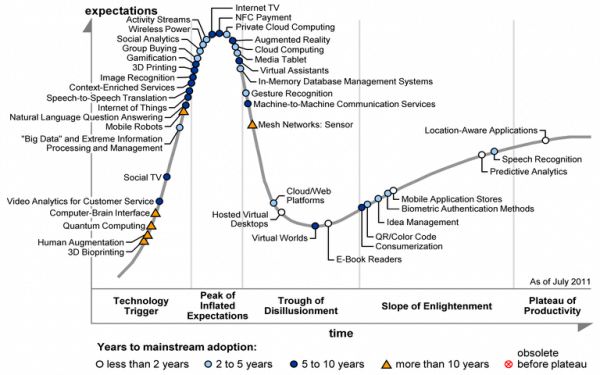
Others that caught my eye at the base of the curve are "Computer-brain interface" and "Human augmentation". Be afraid, be very afraid...
Gartner Hype Cycle 2010
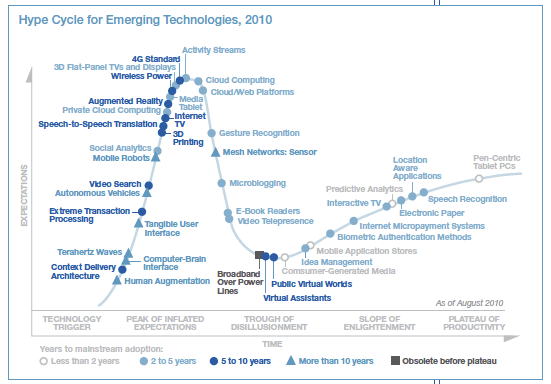
Gartner have just released their 2010 Hype Cycle of emerging technologies. If you don't know it, this is one of the best ways to find out about the upcoming technologies which may affect digital marketing.
The most interesting for me are always those rising up the "peak of inflated expectations", currently those looking most relevant for marketing are:
- Video search
- Augmented Reality
- IP TV
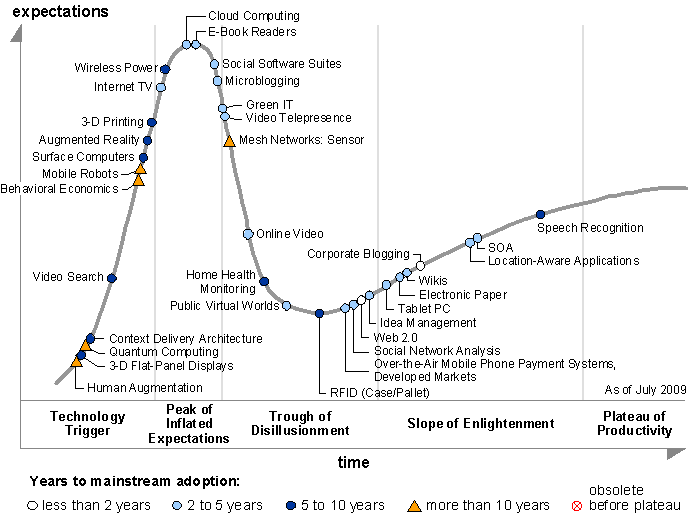
Gartner Hype Cycle 2009
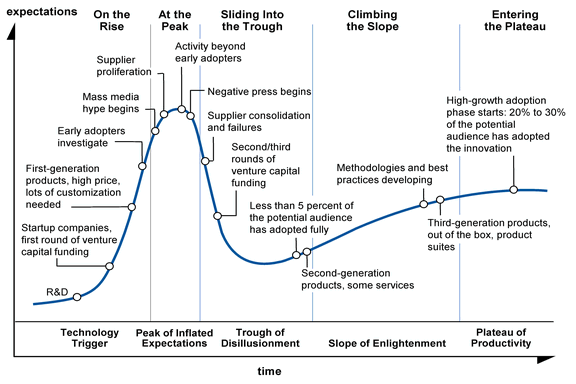
Here is my summary of the 5 stages of diffusion of innovation used by Gartner - it can be useful for explaining to colleagues your strategy when you have adopted a "wait and see" approach because you don't want to waste time implementing a solution that never gets out of the "trough of disillusionment". Alternately, in digital marketing, many smaller, nimble companies have gained an edge amongst early adopters of an approach such as social media or Web 2.0.
1 Technology Trigger – The first phase of a hype cycle is the ‘technology trigger’ or breakthrough, product launch or other event that generates significant press and interest.
2 Peak of Inflated Expectations – In the next phase, a frenzy of publicity typically generates over-enthusiasm and unrealistic expectations. There may be some successful applications of a technology, but there are typically more failures.
3 Trough of Disillusionment – Technologies enter the ‘trough of disillusionment’ because they fail to meet expectations and quickly become unfashionable. Consequently, the press usually abandons the topic and the technology.
4 Slope of Enlightenment – Although the press may have stopped covering the technology, some businesses continue through the ‘slope of enlightenment’ and experiment to understand the benefits and practical application of the technology.
5 Plateau of Productivity – A technology reaches the ‘plateau of productivity’ as the benefits of it become widely demonstrated and accepted. The technology becomes increasingly stable and evolves in second and third generations. The final height of the plateau varies according to whether the technology is broadly applicable or benefits only a niche market.
Selecting alternatives for marketing innovation
Selecting amongst hundreds of alternative projects is a challenge I commonly hear when talking to digital strategists. One approach I have developed when consulting, to help with this, is the matrix below which I describe in my Econsultancy Guide to managing digital channels. Of course this structured approach won't fit the culture of all organisations, but even a simple unscored version of this is useful within a workshops to help discuss the relative merits of different digital projects.
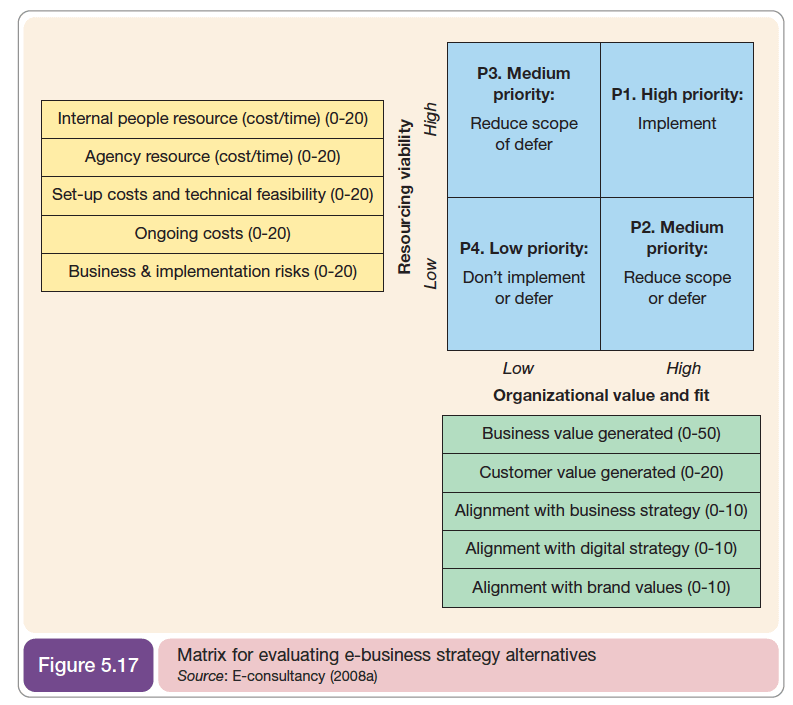
Forrester have produced a "HERO" Project Effort-Value Evaluation tool which works in a similar way:
</p>