Perhaps it’s customer engagement
There’s a huge irony in marketing now - I feel - one that ignores understood, proven mantras of direct, or one-to-one, marketing stretching back decades.
“Your future prospects resemble your best customers, and that’s the place you should start.”
Holger Schulze, vice president of eG Innovations
Put existing customers (consumers) first in marketing planning
It doesn’t matter how advanced modern marketing gets, how intelligent our advertising, our targeting and re-targeting, our key-phrase strategies in search and our use of social and mobile advertising. Marketing success and commercial growth rely on strategic thinking and most importantly begin with customer retention and loyalty before acquisition. Yet how much marketing spend do we see launched into cold reach and acquisition compared to the spend volumes in how we add value to our customers and leads? Is it possible then that we’re over-spending on acquisition and underspending on the sustainable opportunities in customer engagement and retention as outlined in our new customer retention guide?
Customers also reveal hidden acquisition opportunities
Cost effective acquisition requires that we start with understanding and engaging the current customer base, using this customer intelligence as our start point in acquisition to best:
- Empower and motivate customer referral and recommendation
- Improve lead management - lead conversion, engagement, and referral
Only by driving the best value in our current database can we then demonstrate that spend is best moved to new, cold acquisition - where modelling on the success that we already understand can once again aid in laser targeting spend in the appropriate channels and platforms. So before we tail off with budgets aligned to acquisition and growing new reach from cold - regrettably too often with a disproportionate spend in paid media - how about starting right back at home with who you already have proven to be your profitable customer segments?
Customer engagement and lead management
Plan for success by starting with customer lifecycle economics at the heart of strategic planning - this has long been promoted as key to growth and profit, indeed Harvard Business Review back in 2000 demonstrated that increasing customer retention by 5% increases profits somewhere between 25% and 95%. Research only last year by Econsultancy revealed that though 70% of respondents agreed that “it is cheaper to retain than acquire a customer," only 30% of the same respondents were committed to investing in customer retention. 22% stating they undertake zero relationship marketing spend. So, when will we learn and apply what’s long understood - and dare we say it, pretty obvious?
“You can’t keep putting the same stuff on all these channels, or it’s going to get annoying…. We need to aim for ‘distinctive ubiquity,’ so we need to be everywhere but we need to continue to surprise and delight our customers in a relevant and consistent way wherever they are.” — Mark Schaefer, author and executive director at Schaefer Marketing Solutions
Our recommendations for building relationship marketing into your plans
Know your brand, values and positioning. A common throw-back of avoiding a commitment to content relationship marketing is actually knowing what to communicate about - outside of product and promotions. “We’re not Coke, we can’t do that, it’s expensive”. Knowing your brand, where it’s credibility and position is - vs where it can be - as well as it’s values and areas of expertise defines the space where your brand can create focussed content that resonates. This is not just a ‘Coke’ or ‘Dove: Real Beauty’ theory - any and every brand can design a space to connect with consumers outside of just product. This is where relationships, over product promotion can open up digital marketing. And where content marketing opportunities abound across the full lifecycle of a consumer, when the prospective buyer is not in “’buy mode” - let’s face it that’s 99% of the time.
Do you know who are you serving? Customer or consumer segments enable the understanding of unmet needs and motivations, as well as the delivery of a personalised experience. Relevancy is key, and that is where personalisation comes in. What data do you hold about your consumer that enables segments, or personas, to be clearly defined - which are the priority personas that offer commercial value, and how will you ensure you’re relevant in those first 5–10 seconds? A/B testing will help to ascertain what is effective for each segment or persona, and it’ll help your business personalise your site’s experience to attract and retain relevant customers.
Marketing as service, entertainment or both.From McKinsey Loyalty Loop’s to Google ZMOT - customer engagement through content or utility remains a key digital marketing strategy, but what are the key areas to develop understanding and get else started? Becoming a trusted advisor to your consumer or customer base is a well understood but little fellowed strategy - equally adding value to their world in the form of entertainment. After all we still hark to the same old brands who nail it - from Dove to KLM, Red Bull to Coke. There’s never been a time like now that enables not only the access to know-how, technology and resource - but the blueprint of other brands to deconstruct how to add value
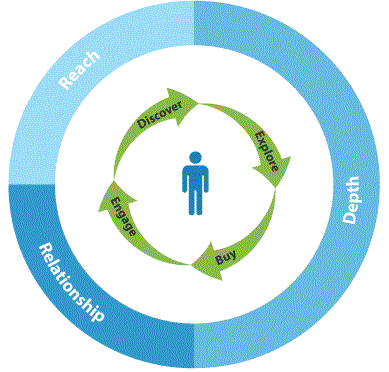
Hone in on your customer lifecycle. Where we may profess to be customer-centric, the truth is organisations tend to focus on a pretty linear view of new customer acquisition. We largely ignore, or at best assume, if, how and when the customer wants to interact with our brand. Forrester’s Customer Lifecycle report in 2011 asked markers to think about the four dimensions of Discover, Explore, Engage and Buy. This is a great start point to consider the dimensions and related strategies that alter at different stages - considering channel, device type, needs and motivations, and content relevance.
“We need to engage consumers emotionally. We need to give consumers a reason to listen to our message. This is about seduction — not repetition.”
Michael Aidan, head of digital and vice president of digital brand platforms at food corporation Group Danone
Build relationships over individual transactions. This is where the Paid, Earned and Owned media model can be really destructive - though I love it for different reasons - because it does not represent how customers perceive and use media. POE is helpful for our marketing convenience in media planning - and nothing else! We need to design communications programmes that add value and put the customer in the middle. Worry not, Forrester can help us again with their RaDaR model - this helps us to see how the Reach, Depth and Relationship model can be made practical.
- Depth channels tell your product’s story. Your website, stores and your salespeople share that same purpose: they offer customers and prospects the detail they’re seeking in their decision-making.
- Relationship channels serve your existing customers, and/or brand fans. The people who remain signed up for your mailing lists or follow you in social media are existing, satisfied customers or fans. These channels aren’t directly about attracting new consumers — they’re about staying in touch with your biggest fans and inspiring them to share your stories.
- Reach channels get you into the consideration set for lead generation and of course sales. Your purpose for using these tools and channels is to encourage customers to explore your brand and product offering in greater depth. It’s just as important, and easier, to engage around the brand at this stage, to build relevance and trust through content than it is to expect sales.
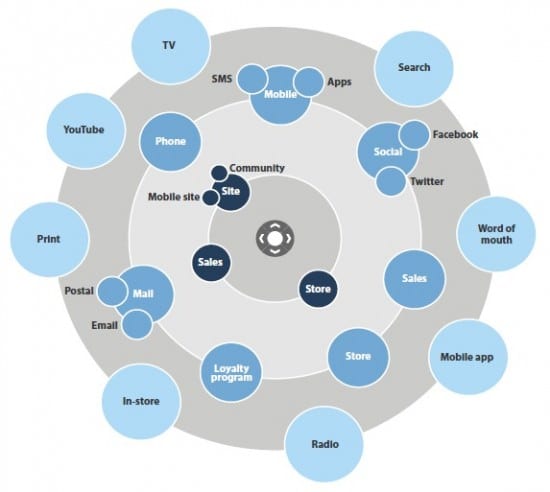
A commitment to data and measurement. There’s no one piece of the Forrester model that is more important at any one time, they simply come to the fore at different stages in the customer lifecycle. Ignoring one or more of those Reach, Depth, Relationship stages is going to leave you under-performing. Using data is therefore the critical success factor so that you know, through both implied and explicit behavioural data where your prospect, lead or customer is at - and how you might best serve them.
What's your experience - how do you see the importance of relationship marketing alongside the reach and acquisition focus that dominates our industry?