Five ways to frame our thoughts and actions as leaders
As marketers, there will inevitably come a point in many of our careers when we’ll be asked to step up from operating as individuals focused on specific tasks (e.g. SEO specialists, digital analysts, web developers) to managers responsible for a group of specialists (e.g. digital marketing manager).
Whether you make the move into management depends entirely on you and your personal drivers (and whether it’s right to promote people based on their technical skills is a debate for another day). But if you do decide to take the route into management, it's important to consider the implications.
Download our Free Resource – Marketing careers and skills development workbook
Our guide shows you how to map out your personal short-term and long-term goals, become more productive in your day-to-day work, identify your key motivators, analyze your digital marketing skills, how to leverage your strengths, and understand the different paths you can take to reach your goals.
Access the Marketing careers and skills development workbook template
Management vs. leadership
Being an expert in your field does not necessarily mean you will be a good manager. The skills required for management are totally different from operating alone and if you are to succeed as a manager these must be taken into account. For example, if you’re managing a team you have to consider other people and achieve results not only by yourself but through others, too.
According to John Kotter, Konosuke Matsushita professor of leadership at Harvard University:
“Management is a set of processes that keep an organization functioning. They make it work today – they make it hit this quarter's numbers. The processes are about planning, budgeting, staffing, clarifying jobs, measuring performance, and problem-solving when results did not go to plan."
We can see from this definition that good, effective management is essential to ensuring a business functions efficiently and that people have clear goals and targets based on the organization’s objectives. However, what this definition does not include is any reference to ‘leadership’. And that’s because leadership is a very different quality. Kotter again:
"Leadership is about aligning people to the vision, that means buy-in and communication, motivation and inspiration."
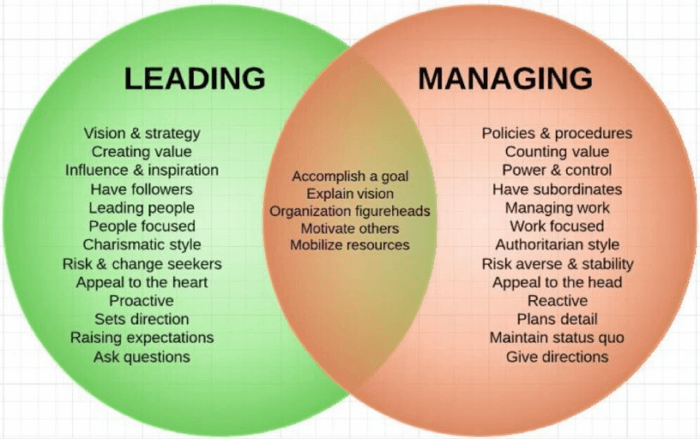
Management is often conflated with leadership, which can cause confusion within the workplace. Whilst management and leadership do work hand-in-hand, there are also clear differences (and overlaps):
As part of our roles as managers, we may also be asked to lead. Many organizations see opportunity to develop leaders across different levels. In a
report for Deloitte, the research team found that:
“Companies face new leadership challenges, including developing Millennials and multiple generations of leaders, meeting the demand for leaders with global fluency and flexibility, building the ability to innovate and inspire others to perform, and acquiring new levels of understanding of rapidly changing technologies and new disciplines and fields.”
In other words, in order to compete effectively in a dynamic, global marketplace, organizations need to have leaders working in every part of the organization - we can no longer depend on senior management and leaders.
The importance of effective leadership
The term ‘leadership’ can be daunting to some. However, leadership does not necessarily mean shaping a grand vision, speaking to hundreds of people or steering an organization through a troubled time. For new managers, the leadership journey starts with small steps, for example how you lead and inspire those around you or set out a simple direction of travel.
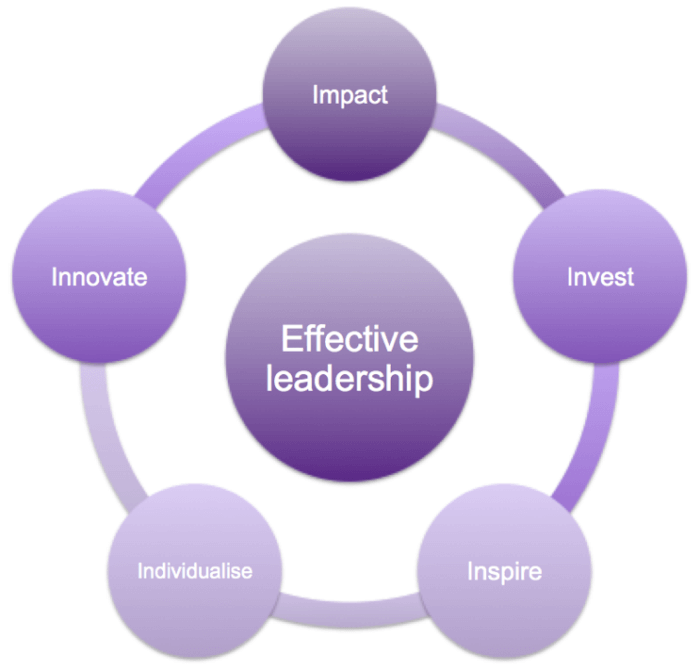
Organizational consultant Paul Scadding uses a ‘5 Is’ model for effective leadership. This is a useful framework for breaking down some of the key areas that new managers can refer to in order to build their leadership skills:
Impact
How do you impact others? Do you energize, deplete, frustrate or panic others? Impact is not about being perfect but setting a daily intention as to how you hope to impact others.
How we speak and act is impacting everyone around us and it’s important to manage this in a way that is authentic to you and your chosen style of leadership.
Invest
Investing time and energy in those we manage is important and is a key component of effective leadership. Managers who invest stand out from those that don’t and make a disproportionately more positive impact on the team.
However, good leaders will also recognize when they are over-investing. A balance needs to be struck otherwise stress and burnout are potential consequences, which will limit us as leaders. If you’re concerned about over-investment, ask yourself the following questions:
- Can you switch off once you leave work?
- Do you go to bed worrying about conversations? Do you try to put off or avoid ‘difficult’ conversations?
- Do you struggle to say ‘no’, create boundaries and priorities?
- Do you micro-manage and restrict freedom for people to manage their own work and grow?
- Are you a people pleaser? Are you able to give people what they really need?
Inspire
You don’t need to be Steve Jobs, Michelle Obama or Richard Branson to inspire others. To inspire others you need to be inspired yourself! Try this reflective exercise:
Who Inspires You As A Leader? List the core 5 qualities that you admire in them
If you’re struggling to think about where you can get inspiration, consider the types of things that has piqued your curiosity and imagination in the past:
- What are you reading?
- What are you watching?
- What are you listening to?
- Who are you spending time with?
- Who are your role models?
Individualize
If you’re managing other people, you need to treat them as individuals with ideas, aspirations and ambitions of their own. New managers can sometimes fall into the trap of using others to meet their goals.
When managing more than one person, consider the differences between each individual. The key is to be adaptable. Some points to consider:
- Get to know your line reports and what they need. You cannot treat everyone the same.
- It’s too easy to judge by our own standards.
- Other people have different levels of interest and investment than you .
- Celebrated the things that make us different from one another.
- You may struggle to meet someone where they are if you have never been through exactly the same experiences (e.g. redundancy, depression, anxiety etc.). Try to understand and at the very least be kind.
- We often see people that don’t do, say or think the way we do as ‘difficult’.
- Above all, people want to be seen and heard and know that they matter.
Innovate
“Innovation distinguishes between a leader and a follower”
- Steve Jobs
Innovation in this context is not about inspiring breakthrough product design or services, but thinking about what you can do differently as a leader within your role as a manager.
Standard line management practices do not always reflect good leadership. Some ideas to consider include:
- Make leadership your own and develop your own style.
- Instead of sitting down in a dull office, try ‘walking’ one-to-ones with your team.
- Reframe language and be clear.
- Share best practices with each other.
- Lean on others for support, e.g. “How would you tackle this situation?”
- Call on the experienced people in your team - you do not need to lead alone.
Conclusion
Management and leadership may be closely connected but there are clear differences between the two. Whilst management is primarily about delivering goals and targets efficiently, leadership is about recognizing that the people you’re working with are human beings with thoughts, feelings and aspirations that can be harnessed as part of a healthy, balanced working culture.
Whilst leadership may come more naturally to some people than others, it’s something we can all practice as part of our roles as managers. The 5 Is model is just one of several ways to shape our thinking and way of working to get us thinking beyond the minimum expectations of line managers.