It isn't always easy to determine exactly why you've dropped in SERPs and have seen a traffic dive
You might know the 'flush of victory' when your content eventually hits the first page of search results and attracts significant traffic. Can you imagine the moment it drops one day? Perhaps, this has already happened to you?
You’ve taken the effort and have created high-quality content, which should have been fresh and engaging for quite a long time, but something went wrong. Time passed and you've noticed that the page isn't performing that well anymore. The reasons for this may not be obvious at all. If you want to know how you can diagnose the problem, recover and prevent the same decline next time, this post is for you.
Download our Individual Member Resource – Managing SEO playbook
This guide is for marketing and digital marketing managers who need to manage Search Engine Optimisation (SEO), either through agencies, consultants or company specialists or through their own efforts.
Access the SEO playbook 2025
What’s wrong with your rankings?
Well, you should remember that in the world of SEO 'search results' and 'stability' are complete antonyms. What does this mean? First of all, search engines are constantly improving their algorithms to provide users with more and more relevant results. Moreover, robots never stop crawling websites searching for the content or updates they could have missed. Once they notice some changes, it affects the results.
Once you’ve noticed your rankings have dropped for several queries, you should check your current positions as a whole. What if the changes you’ve noticed are the tip of the iceberg?
Before you start investigating and fixing the problem, it’s worth tracking all your dropped positions. SEO tools, such as Serpstat and Ahrefs, will provide you with the essential data on your ranking movements. Using Ahrefs, you need to type your domain name, go to Organic search > Organic keywords > Movements, choose Down, select your country, and you’ll see the following results:
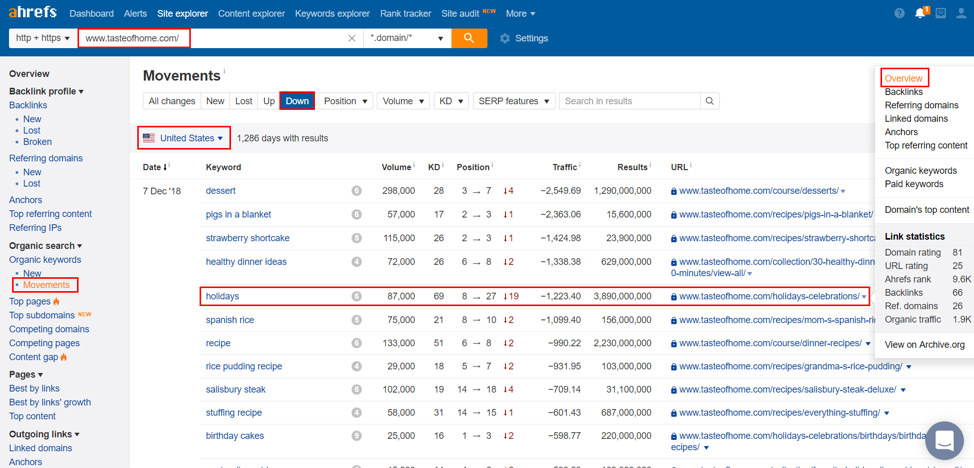
Pay attention to the Keyword, Positions, Traffic, and URL columns. Look for keywords that have seen dramatic drops. Once you’ve identified the pages that have a serious decrease in SERP for a shown keyword, it’s time to move on to identifying the reasons for such a drop.
What you should check to fix the issue
When it comes to the causes of the sharp dip in your ranking, and as a result, in your traffic, there’s no 'one size fits all' fix. Rankings drop is only the tip of the iceberg and there are lots of issues to check before you can find out how to fix the problem.
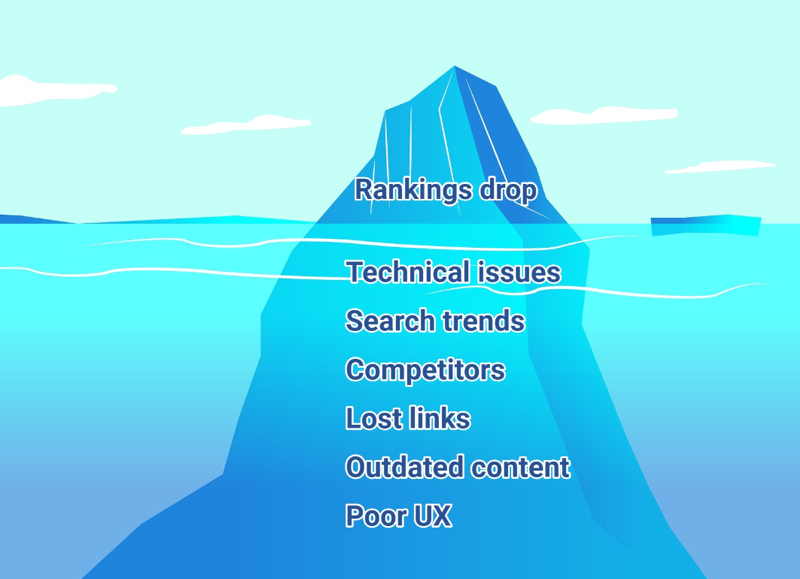
As you see, the process of identifying the problem may be pretty time-consuming. But checking all these parameters will help you recover your rankings and give your content another shot - as well as give you some insight if the same happens again in future.
Technical issues
Even though you optimized your website and everything seemed to be alright, troubles may occur. That’s why it’s worth checking whether search engines still can index your website accurately.
- Traffic - Is your server prepared for high traffic? If surges in traffic have happened, it could have taken your website down.
- Page speed - Check your website speed. When you change something, add images or other types of content to the page, its loading time usually increases, which can pull you down in rankings.
- Redirects - Did you remove or modify your redirects? Remember that when you move to another server or change your website structure, you should set up 301 redirects. Otherwise, such changes will influence the way search robots see your website.
- Canonical tags - Make sure they’re updated once you develop your site architecture.
Search trends
Did search trends change recently? Maybe the keywords that worked previously aren’t popular anymore?
If your content is seasonal and depends on the time of the year or some specific events, your traffic will depend on the date. There’s no surprise that the popularity of 'oscar' as a query goes up in March following the award show:
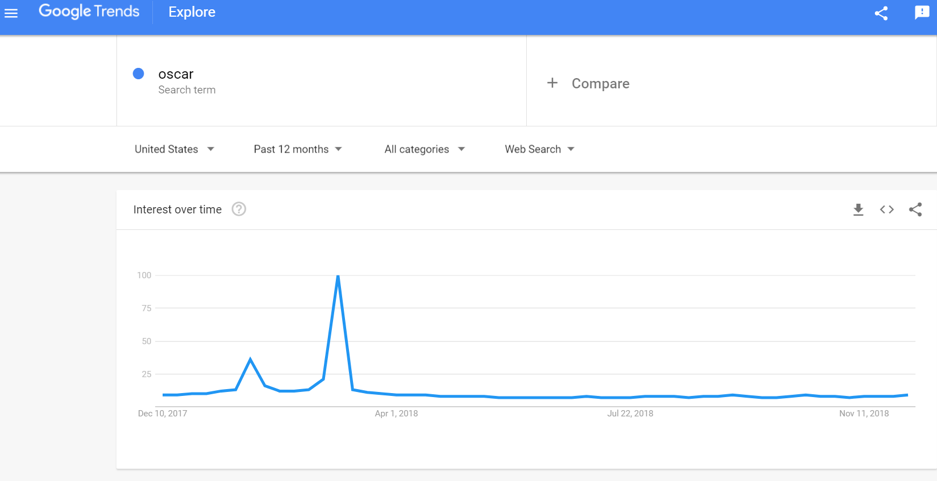
In this case, you can’t make people search for your content and influence your traffic, so you need to look at your overall content marketing strategy.
But what if your business isn’t seasonal? Keywords you choose may fail to work as well. The reason for this is that the way people search today is a bit different from how they searched yesterday. With the increased popularity of voice search, long tail keywords are more important than previously, so you should look at including these in your SEO strategy.
Lost links
As quality links are crucial for your rankings, losing them may cause your SERP drop. That’s why checking and fixing your link profile can give you great chances to recover your positions.
First of all, how do you discover whether you’ve lost links? Such services as Majestic and Moz provide an opportunity to analyze your links and track all your discovered and lost backlinks.
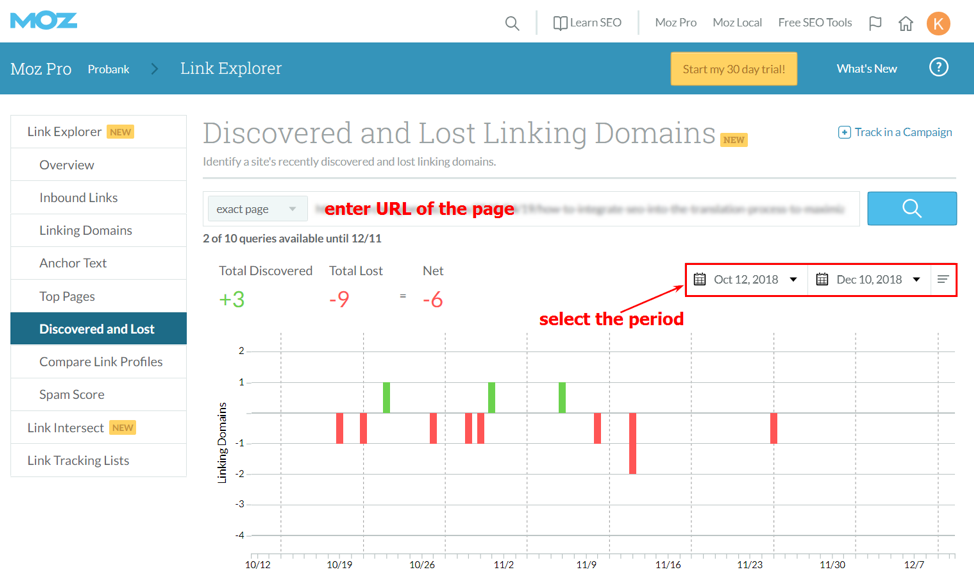
Once you know that your link profile is your weak spot, it’s time to make it your strength. Discover whether these links are broken or if they've been removed for some reason. If they’re broken, fix them. If website owners removed your links by chance (for example, when updating their websites), then ask them to restore links. If they did it intentionally, no one can stop you from building new ones.
Competitors
What if the decline in rankings isn't your fault? You avoided all the mistakes, but your traffic leaves much to be desired. Perhaps it's the case that your competitors developed their strategies and outran you.
Use SEO tools to check how positions have changed over time and who has become a SERP leader for your targeted keywords. Moz, Ahrefs or Serpstat can help you find out your competitors’ traffic, backlinks, keywords, etc. so you'll be able to see if significant changes occurred on their websites.
It's also important to monitor your rivals’ social media and content marketing strategies. What do they write about and how do they behave on social media? All of this could increase their brand awareness and be a result in the traffic uptick to their sites.
When you discover your competitors' strengths, implement the most useful ideas into your own marketing strategy, but be sure to put your own spin on them so they work for your brand.
Outdated content
A simple reason for the fall in rankings and traffic could be that your content has become outdated. Old content is unlikely to be shared or linked to anymore. This issue is easy to fix and you can be sure to prevent it in the future by updating your best performing content regularly.
This tip is extremely efficient for lists and long-form content. For instance, if you made a list of best sites for employers, keep updating it with new links or new resources. This will mean people know your site will have the answers and will help you compete with new sites and resources from competitors.

Poor UX
Sometimes fixing technical issues, proper keyword research and link building won’t help your SEO. Why? As we’re in the era when search engines consider user behavior, a poor user experience could keep ruining your rankings, even if everything else is perfect.
Increasing the time people spend on your website can help to improve your positions significantly. But how can you keep people on your site?
- Provide a simple design. If you want to make your website user-friendly, avoid fancy fonts and complicated designs. If you can’t read the word at a glance, then you should change the font. Moreover, the fewer colours you use in your design, the better.
- Divide your texts into paragraphs. Make it easy for your readers to extract the most important information on every page. If visitors see that reading your content will be a challenge, they won’t even try.
- Use informative headings. Putting the most important information in your headings will engage people who don’t want to read all the text to find the answer to their specific question.
- Clear website structure. Don’t forget about an easily accessible menu bar that lets visitors select the category they’re interested in.
- Make your site mobile-friendly. Mobile users should face no difficulties when visiting your website. Otherwise, you’ll lose half of your prospects, as more people are browsing on mobile devices.
- Avoid pop-ups. Pop-up windows can be incredibly irritating for website visitors, especially if you have several. Use banners that use a reasonable amount of the screen instead.
Keep tracking
To always be aware of your websites’ positions you should keep tracking and reporting on them. Analyze your rankings data on tracked keywords throughout the time since you’ve launched your campaign or made changes to assess what has worked.
If you use Serpstat, the process of rank tracking will be pretty easy. Click on Add New Project, enter your domain, give the name to the project, and click on Create. At the dashboard you’ll see Start Tracking button, click on it. Now you need to select settings and add the list of keywords you want to track. Once the report is ready, you’ll be able to track your positions for the chosen keywords throughout history.
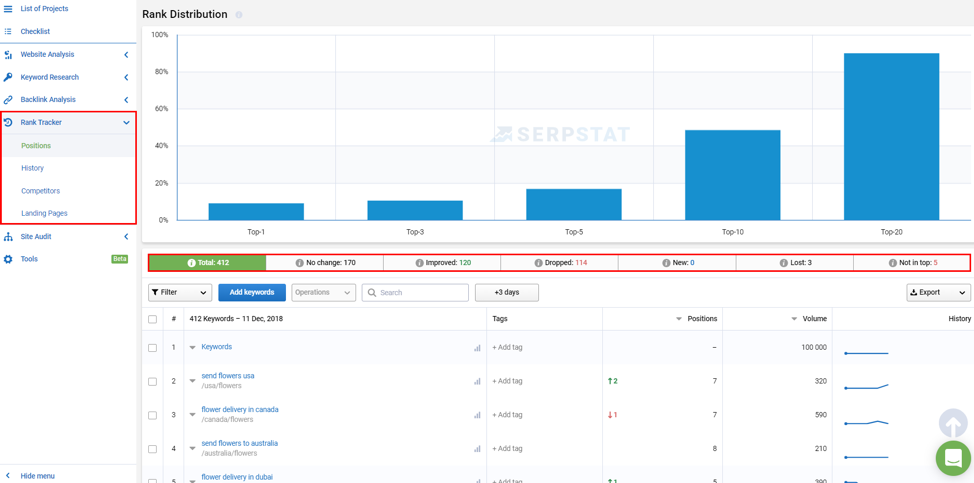
You can see how your ranking changes for particular queries for the last 30 days, view the Top 100 for tracked keywords, positions distribution and other data you’ll need to analyze your rankings movements.
It’s your turn
Now that you know what you should do to avoid or fix the cause of your traffic and rankings drop, it’s your turn to act. Remember that SEO consists of various factors and even the smallest detail may influence your business a lot. Never stop discovering new trends and algorithms to make sure your strategy is up-to-date.
Inna Yatsyna is a Brand and Community Manager at
Serpstat, an all-in-one SEO platform. Inna is experienced in digital and content marketing, along with SEO. She’s fond of writing useful posts, helping people, reading, traveling, and animals (especially dogs).