Google research shows changing patterns of digital media and content consumption
Recent research from Google offers new insight beyond the consumer's shift to mobile, revealing how consumers view content across a number of devices - tablets, smartphones, PC's and of course TV.
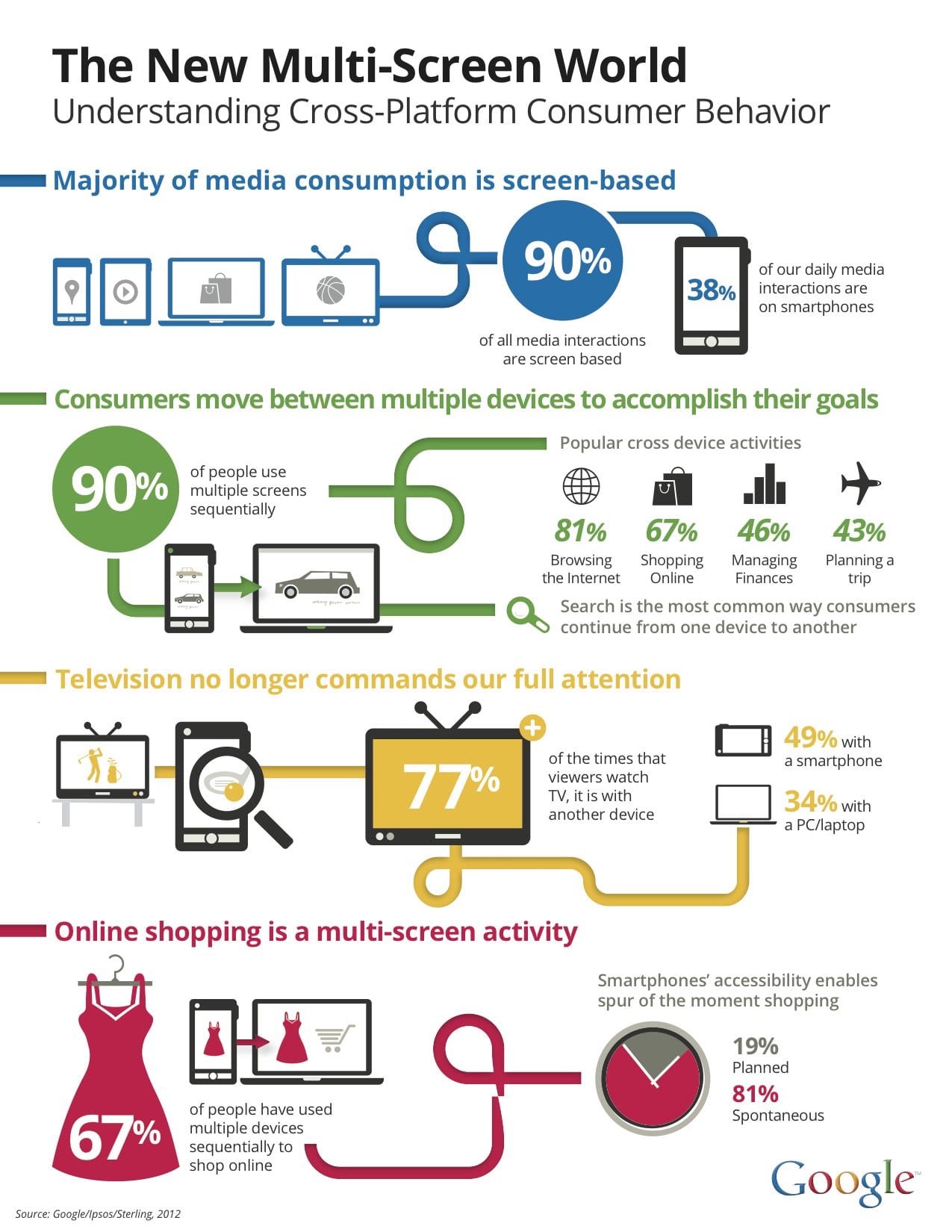
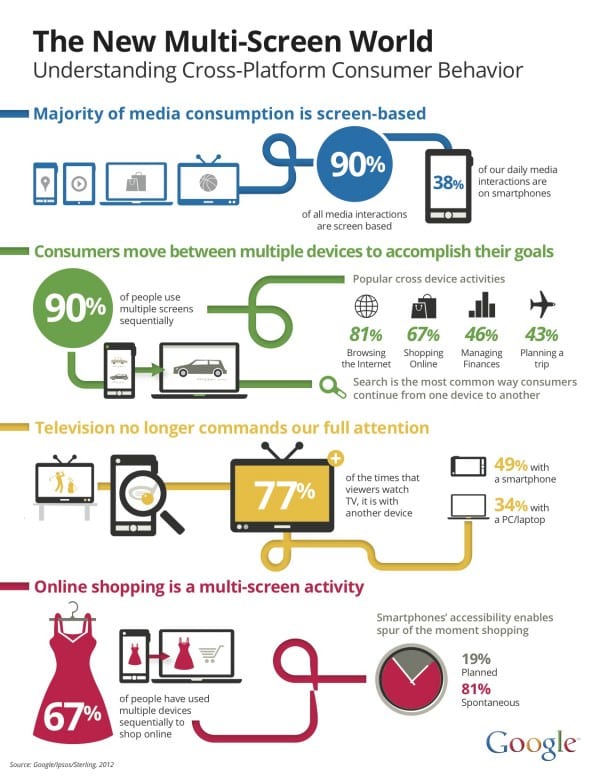
After polling 1,611 people in the US, over 8,000 hours of activity and 15,738 media interactions, the study reveals that the story here is one of integration when it comes to users accessing your web content. 90% of all of media consumption, equivalent to 4.4 hours per day, is happening across tablets, smartphones, PC's and of course TV. The remaining 10% is split across paper, press and radio.
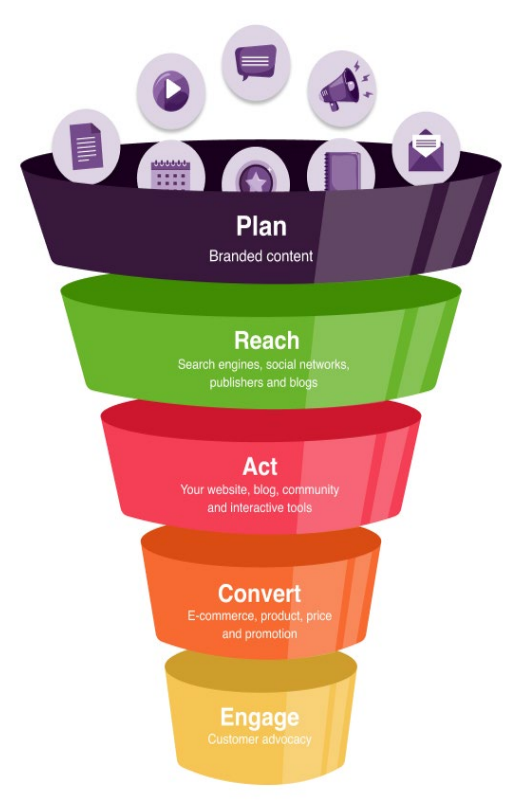
This not only has implications for how content, services and web applications are designed, but how you plan journeys across them.
- Smartphones and apps are used for a relatively short duration at 17 minutes per day session, compared to 30 minutes on tablets, 39 minutes on PCs and the 43 minutes watching TV.
- TV is no longer a solo affair. Though users still watch TV the most, for on average for 43 minutes per day session — 77% of those people are simultaneously using another device like a smartphone or tablet.
Not surprisingly:
- Smartphones are the most-used when it comes to starting a digital experience (referred to be Google as sequential device usage). Most online tasks get initiated on a smartphone while being continued on another device — perhaps with a larger screen for easier use.
- Smartphones are the most common sidekick device used simultaneously with other screens (PCs, televisions and tablets) with both apps, voice and SMS services.
The take-aways?
Persona research: I'd suggest this research requires some early investigation too, to get a snapshot from your user base, how are your consumers interrogating your content in a journey sense - what matters to them, how and when. This Google insight offers some opportunity to steal a march on your competition in the next 12 months.
User journeys: Whilst your total brand experience doesn’t necessarily need to be designed for a smartphone experience, at least the early part feels like it now has to be, integrating that with how that content might be used on other devices — for example, starting shopping research on a phone whilst commuting and being able to finish at home on a PC.
Content and page formatting: Ensure that the basics are in place - is it easy to view your critical content (that gets the most interest and interaction) on a range of devices? Consider content format alternatives that are easy to digest (video, animation, graphics) as well as links to view content in other formats.
What will Google do?
You'd have to think that Google itself will act on this by bringing more to your Google account, the means to tie your behaviour across Chrome in multiple devices, as well as its social network Google+. Getting that right enables users to have a joined up experience by searching on one device and then continuing that journey on different one
Given that Google will have advertising following users along the way, it also implies Google continuing to make sure that it has a role to play across all of the screens. Whether it does so as a software-only player, or also through an increasing role in the hardware itself.
Are you seeing new patterns in how your consumer navigates you content through multiple devices?