With Google's algorithms are changing all the time. What works and what doesn't?
Tim Soulo wrote a rather controversial article two weeks ago, the backlash of which has seen Ahrefs remove all the 'controversial' content. However, this shouldn't detract from the data they extrapolated from the study.
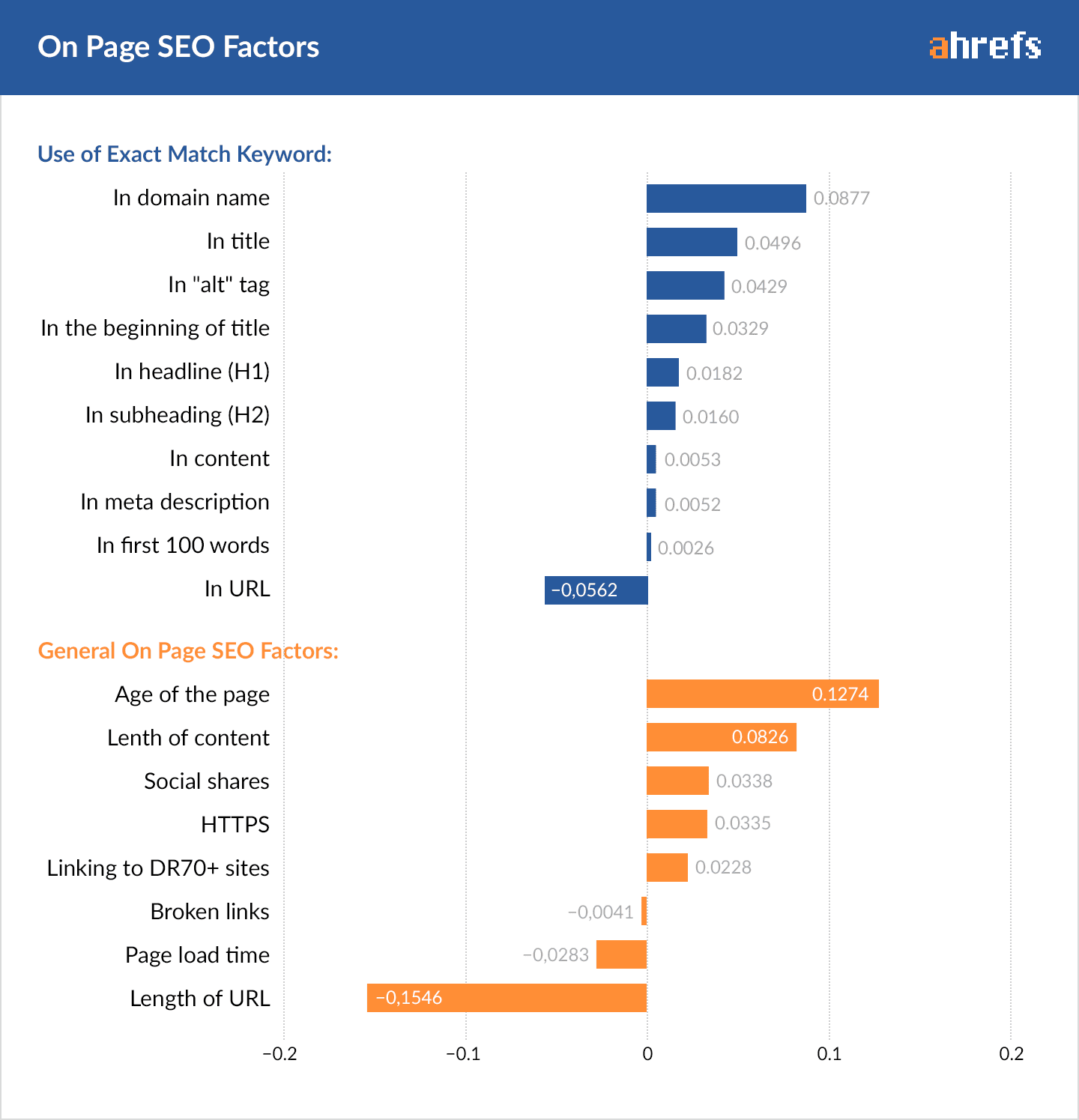
The study was conducted to identify the correlations of different on-page SEO factors, with Google rankings across 2 Million random keyword searches. They were very keen to point out that although correlation doesn't necessarily mean causation, the results are certainly interesting.
What am I referring to when I say On-Page SEO Factors?
Typically when discussing SEO ranking factors, you have three main areas.
- Off-the-page: Which are referring to factors publishers can't themselves impact.
- Violations: Typically underhand tactics, that search engines frown upon e.g. spammy link building
- On-the-page: These refer to the factors publish can actually control e.g. HTML, sitemaps, page speed. It these, that the chart is discussing today.
Use of exact match keyword
Typically when people who are new to SEO, stumble across advice, it indicates that cramming your keyword in your Title, meta's and HTML will warrant a top place on the SERPs.
Although this used to be the case, in a post hummingbird world Google is advanced enough to understand the synonyms, context and the relevance of your content.
The research did find some interesting data though. It transpires having the keyword you're looking to rank for, in your domain can help boost your rankings. Typically it was found this was because these were often brand names, so this may not actually have the impact we initially thought it did. But it's worth bearing in mind.
When trying to rank for keywords, it was shown that almost 75% of pages that rank on the first SERPs page, didn't actually contain an exact match. Once again, highlighting Google's ability to understand synonyms, context and relevance.
Interestingly, out of all of the keyword-related on page SEO factors, there was only one which had a negative effect; the inclusion of the keyword in URL. This corresponds with a recent statement by John Mueller who stated...
I believe that is a very small ranking factor. So it is not something I’d really try to force. And it is not something I’d say it is even worth your effort to restructure your site just so you can get keywords in your URL.
General on-page ranking factors
Addressing some of the more general on-page SEO factors, it's clear to see that there was an obvious correlation between the age of a page and a higher ranking. So perhaps if you're looking to rank quicker, using older pages or updating content is more beneficial than churning out tonnes of fresh content.
Once again, the only negative effect refers to the URL. This time it refers to the length of it, or more pertinently, the amount of folders it is attached to.
Why this is, I'm not too sure. My best guess is to encourage a better UX, as they won't need to dig so deep on the site to find the content.
- Source: Ahrefs
- Data Set: 2 Million random keyword searches