This research report from Quantcast is particularly interesting, especially given their specialist expertise in the display advertising category.
The premiss of their report is essentially
- People who are on a website have different needs to those searching for one, yet digital marketers look to optimise for clicks in similar ways.
- Search advertising is an understood CPC (cost per click) model, where buyers have an intent and are served advertising that they’re interested in. In short, if you’re happy with the CPC, it works.
- People on a website tend to want the information on the website, not look to click a banner and leave it, there is a reason or intention to click away at the earliest opportunity - regardless of whether it’s a display ad or link.
- Click conversion is better aligned to where there’s purchase intent and a desire to click. This is inevitably lower down the sales funnel.
- Click measurement is not a very valuable way to understand the effectiveness of display ad effectiveness. In this instance clicks aren’t just sub-optimal, they’re anti-optimal.
A reason for display advertising
As effective as search advertising is, Quantcast suggest (and logic dictates) that a singular focus on this approach can only lead to missed opportunities. This is because less than 4 percent of consumers’ online time, less than 3 minutes in an hour, is spent on search. The other 96 percent is spent doing things like reading email, browsing content, watching videos and engaging in social networks.
Why Clicks miss the point
If you look horizontally at the table below you can see that the clicker profiles look different from those of actual converters for both campaigns. Whereas when you’re looking vertically you see that clicker profiles are similar, regardless of the category.
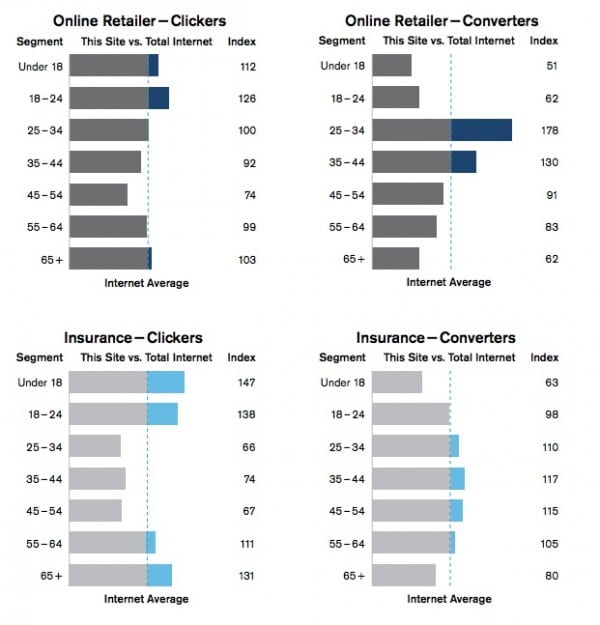
Source: Quantcast Internal Data Index compares each metric to the US Internet average (100 = average)
On top of this Quantcast also stress the people are generally clicking less and less on ads, heavy clickers are now just 4 percent of users from 6 percent 2 years ago. Yet clicks remain a significant digital marketing metric.
The take-away is obvious, I’d hope. Despite the click profiles being the same, display ad clickers are NOT converters, or at least not immediately anyway…
Focus on the conversion
Your objective, I’d expect, is a conversion of some sort - the click is a useful but arbitrary KPI, in-between views and conversion, right?
So rather than being click focussed, Quantcast suggest that you view the campaign through a different lens and optimise your display campaign using the four steps below as a guide:
- How is you campaign performing in terms of understanding the characteristics of your click-based (clicks) and view-based (impression) audiences. Monitor the relationship between the two, by campaign.
- Measure view-based conversion volume as well as click-based conversion volume. Buyers are likely to take another look, and perhaps multiple, before deciding to convert to purchase.
- Judge your campaign by the eventual conversion rate rather than the click-through rate. Or better yet, use effective cost per action (eCPA) to measure the effectiveness of your entire advertising investment no matter how you’ve bought it.
- It’s depending how much you’re spending of course, but you may consider a multi-touch attribution approach. This involves building a model to better account for the impact of all of the ads that touched your customers along their path to purchase, over time and across multiple websites, and can help you overcome the shortcomings of click-based and last-touch attribution (attributing all credit to the last ad seen).
It’s important to keep the consumer front and centre, you’re optimising for someone to eventually do something, keeping a human eye on this is crucial. So much media buying makes the human side abstract, numbers over common sense. Of course we want to be driven by data - it’s simply down to the questions that you ask of that data though, isn’t it?