How should companies align their marketing activities with business goals?
By Jim Sterne, Founder of The eMetrics Summit.
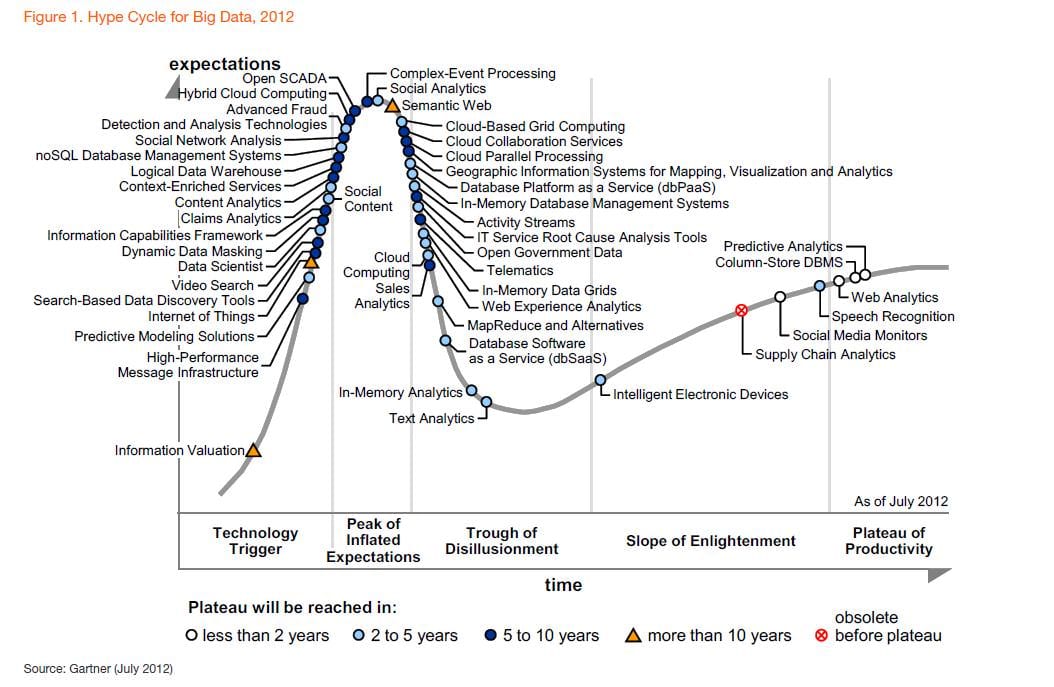
Source: Gartner Hype Cycle for Big Data
Big Data, as the name would suggest is, well….big. With so much you can measure, what should you measure? With so many measurement options, the more difficult question is no longer about standards or technologies, but about goals. What are you trying to accomplish?
You can answer that question as a business: raise revenue, lower costs, increase shareholder value, etc. You can also answer that question as a profit center: increase profit, grow market share, increase customer satisfaction…
But the real attention-getting question to ask about goals is personal.
How are you compensated?
The manager who will only make his annual bonus if customer satisfaction goes up X% doesn't seem to mind going a bit over budget. The one whose income depends on cost cutting has a more conservative perspective.
Having spent 10 years as a sales rep, thoughts of compensation are hardwired into my head. I am forever trying to accomplish one of two things:
1. Alter compensation to match organisational goals.
2. Align metrics with compensation.
It's difficult to get people to talk about how they earn their bonus. To begin with, it's astonishing how many people simply don't know. They were given a speech about their productivity and contribution at the start, but discussions about recompense are few and far between and are considered an inappropriate topic for public conversation.
I don't want to know how much you make - that's none of my business. But unless you know and are willing to discuss the basis for your income, you can't implement metrics to help you measure your success.
Where to begin?
So begin with your company's goals. Yes, we want to raise revenue, lower costs, increase satisfaction, and beat the pants off the competition in terms of the number of patents filed and cool t-shirts we hand out at trade shows. But which of these takes precedent?
A manager's pay should be tied directly to specific changes in specific metrics over specific time periods within specific budgets. It's important that the recipient not control the measurement methods (so he can't game the system) but has a contract that stipulates the rules of engagement won't change. That way everybody can track the numbers with confidence.
Once you clarify your goals, the proper metrics will become apparent, as will the systems to capture the data necessary to track those metrics. Analysing more and more detailed metrics can be a great help right up until they reach that mystical point of diminished returns.
If my goal is to increase online sales, then only measuring sales won't give me any visibility into the selling process. I'll want to drill down and measure traffic source and click-streams - the various ways people arrive at and meander around my website - in order to improve usability and speed the sales process.
I can measure the effects of altering the words I use to describe my offerings. I can track the types of questions the call centre fields and try to answer those questions in an FAQ before people have to ask.
With state-of-the-art customer behaviour analytics tools, I can measure every keystroke and the X-Y coordinates of each and every mouse movement in order to assess customer behaviour within every page on my site. This is where the return on investment (ROI) issue comes into the picture.
If I collect too much data, if I produce too many reports, if I have too much information to consider, then the cost of collecting, storing, analyzing, and reporting that information is, by definition, more expensive than the benefits I can derive from its use as a decision-making tool.
What's the right balance?
Align your metrics with your organisation's goals and you give everybody the power to track their own success and do their best to meet their (and your) goals. Just don't let them get bogged down in the details. Metrics should be useful, rather than merely interesting. This is bound to strike a chord for many at the London eMetrics Summit on 27-28 November.

Thanks to Jim Sterne for sharing his advice and opinions in this post. Jim Sterne is an international consultant focused on measuring the value of the online marketing for creating and strengthening customer relationships. Sterne has written eight books on using the Internet for marketing, produces the
eMetrics Marketing Optimization Summit and co-founder and current Chairman of the
Digital Analytics Association. You can follow him on
Twitter or connect on
LinkedIn.