When is the best time of day to send an email?

Examples of testing the best time of day for email broacast

Last week we looked at the ideas on the best day of the week to send an email for different audiences.

This week I review a related issue, asking:  ”is there a best time of the day to send an email?” Again, the answer is “yes, definitely”, but it depends, so you have to test it. It depends on audience, but I hope these 3 examples show it’s worth testing.

Update – September 2011

I spotted a nice, simple infographic to support the stats later in this post. It can help you review the factors that may affect consumer attention during the day. These considerations also apply in B2B and the attention available during the office day – for example we find our newsletter works best around 8-9AM as can tweets/shares – also around lunchtime – although that’s called the “Abyss” here – a reminder that rules are made to be broken – and tested.

Talking of testing, I’d also recommend this recent post by Tim Watson that asserts ““.

I’ve been in touch with Tim while writing this post and here is the link to the original case source in the Enewsletter (with previous company branding). He said he wouldn’t be surprised if the situation has changed now, since with more mobile use email reading patterns have changed. He went onto say that he recently ran a structured test plan across days and times for a client and found that time of day was not so important for their emails but day of week was.

B2C campaign example

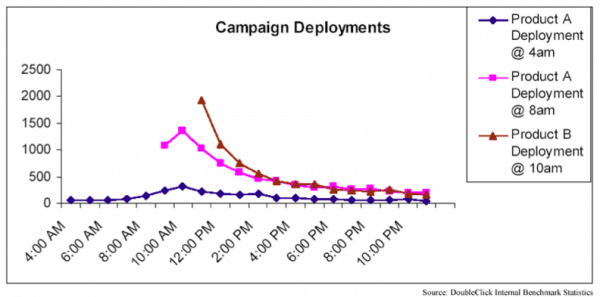
This second test gives a second type of insight. It shows how to run an email test with different broadcast times to review the response. The first deployment at 4AM is clearly ineffectual since most subscribers will be asleep and when they come into work or log-on at home will be working on other activities at 8AM. The 10AM deployment is most effective.
Individualised Email broadcast example

A really sophisticated approach to determining the best time of day is to personalise!  Retailer eBags individually calculated the best time to send the email by looking at the behaviour of each user within the email list, recording the exact time when they signed up to the list. A test they ran found using this broadcast time found that…

  • Click-through rates increasing by 20%.
  • Conversion rates increasing by 65%.
  • Average value per order increasing by 45%.
  • Overall average revenue per recipient increased by 187%.

So the takeaway from these example are that targeting, creative and relevance of the offer may matter much more, but testing may show that you can make your email campaigns more effective through selecting the broadcast time. For further reading, check this on email timing tests from Email Marketing Reports.

This entry was posted in Email communications strategy. Bookmark the permalink.
  • Darren

    Is there any evidence of when to send to emails based on demographic? For example, with B2C campaigns targeted at teenagers, should we be sending emails at a different time to campaigns aimed at their mid 20s?

    • http://www.smartinsights.com/about-dave-chaffey/ Dave Chaffey

      That’s an interesting question Darren. Everyone running email campaigns looks at open, click rates, but it’s much more useful looking at these measures for different demographics.

      So I can’t answer your question, but as a starting point it’s worth segmenting by demographic and seeing how response varies. Of course it will also vary by quality of targeting and creative but I’m amazed how difficult ESPs make it to do this analysis – reporting by segment should be as easy as it in Google Analytics!

      Has anyone seen data on this or tested this to answer Darren’s question?

  • http://twitter.com/EasyInbox Steve Henderson

    Does broadcast time have much impact on who reads the email and when they read it?
    People on twitter see notifications, alerts and communications pass by every other second. Read it or miss it. If you are not connected you might miss something.

    Email is much more polite and considerate.

    Email does not mind if you are in a meeting, in bed, away camping, making a coffee or whatever; an email quietly sits and waits for you, knowing that when you have time, you will come and have a look to see what is interesting or important.

    Some people are time-sensitive to email, but some are not. My personal studies (mainly B2C across various industries) show that the majority of people are not time-sensitive when it comes to email.
    Instead, other things (see subject line CURVE http://j.mp/nkkKSe) have a greater impact on opens than send time.

  • http://www.smartinsights.com/about-dave-chaffey/ Dave Chaffey

    Thanks Steve! I like CURVE – have seen before – not on this site though. AB testing supports your argument – shows that subject lines can have a big impact certainly.

    I would say that there is still a similar effect with email to social status updates in that individuals do tend to respond more to what arrives in their inbox while they are using it or through an alert. If they return to email inbox and are working through a whole bunch of emails, e.g. first thing in the morning, then they are potentially less likely to click through since there is more competition in the inbox.

  • http://www.digitaltrombone.com Anders larson

    Hi Dave!

    Thanks for the insight! There is some common sense in sending out early, since there are more hours during the day where the mail potentially can be opened. Do your tests include information about when the mail where opened, compared to the time they where sent?

    I would assume that many B2C campaigns would gain from being opened after work, especially if there is an incentive to click and buy something. Would that be a reason for sending later during the day, and exchange high open-rates for higher convert ion-rates?

Feedback Form
Feedback Form