Why don't many companies blog?

What are the barriers stopping companies blogging and how can they be encouraged?

I strongly believe that every business should have a blog since they’re an essential hub to your digital marketing activities. If you don’t have one, you’re missing out on one of the best ways to engage existing customers and to get new customers through the power of advocacy and SEO. So we’re on a bit of a mission to get more companies blogging, but know we need to understand what is holding companies back.

I find when I ask in my training workshops, that often only a quarter to a third on the course have a blog. So there must be some serious reasons behind low business adoption of blogs. In the spirit of encouraging more companies to adopt them I’ve summarised here the reasons for and against. But first a poll – thank to those who helped devise the questions via our great Linked In Group discussion on reasons for not having a blog!

Thanks! for voting in our survey where we try to better understand the reasons that stop companies blogging.

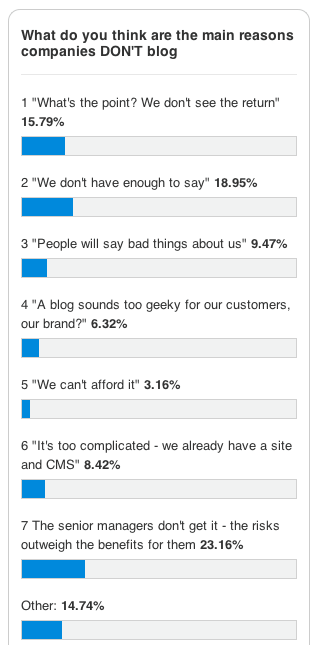
The results show 3 main factors are the most important barriers:

1. The senior managers don’t get it – the risks outweigh the benefits for them (23.2%)

2. We don’t have enough to say (19.0%)

3. We don’t see the return (15.8%)

Other was also a popular category where most talked about lack of time or the right specialists to write it – which clearly should have been a question!

  • Not enough time to write it
  • People are lazy. Don’t want to put in the effort to keep a blog up.
  • Competitors finding out too much
  • Not clear who should own it
  • Not enough time from contributors or to manage
  • Not enough time or resources
  • We don’t have anyone with enough subject knowledge who has the time
  • Time within the team – we’re stretched to capacity already
  • Don’t want to start one without a strategy in place for creating content
  • There no time to write a blog
  • We don’t have the time!
  • My “we can’t afford” = don’t have the time resource available

Why blog may be the wrong name

As a starting point for the barriers, I think many companies are put off by the name – it can sound too geeky and maybe customers don’t know what a blog is.

But it can be positioned differently; as a magazine for example. A great example of a blog, powered by the free tool WordPress, which doesn’t appear as blog in the normal sense is the ASDA Online Magazine.
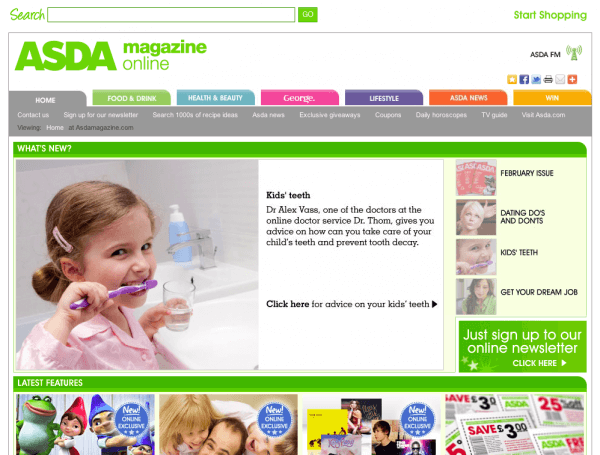
What do you think? I think a customer magazine works better for the company and the customers. I can imagine it would be a lot easier sell to the corporate communications team.

More reasons companies don’t have a blog

Here are the reasons I hear most often, if you hear others, please let us know via the comments.

1. “What’s the point, where’s the return?

The return on investment for a blog is certainly hard to prove in a monetary sense. But a big part of the business case is within SEO – where I think a blog is now essential to effective SEO, particularly now Google uses signals from social networks to rank pages.

This survey on blog SEO by The Top Rank Online Marketing Blog found that the vast majority of respondents found it was important to their SEO efforts. The chart shows how blogging helps.

Other key business benefits of a blog to build into the business case are:

Blogs are also dynamic to technology changes – plugins make them easy to extend

2 “We don’t have enough to say?

The counter argument is that you probably DO have enough to say for an enewsletter or through press releases? These can be repurposed for the blog. You HAVE to find enough to say to keep followers on social networks engaged and the blog provides a hub for this.

3. “People will say bad things about us

True, but detractors will say the same about you elsewhere where it’s less easy for you to manage and comment.

Of course you can moderate, with a commenting policy saying what’s in and out. So only posts you authorise go up – I think that’s often not understood.

4. “A blog sounds too techie/too geeky?”

This is a fair comment – I think blogs are maybe associated with tech site or personal blogs rather than companies.

In that case maybe position it as a customer magazine – as with the Asda example above. This will sit better with corporate communications teams in a larger organisation.

5. “We can’t afford it

This is an easy one to argue against. Many of the CMS described above are open source or require a small outlay for a theme. Yes, you will need a designer to update the skin, but total cost could be 100s rather than 1000s. The real cost is the staff time to edit it or to outsource this. That resource does have to be

6. “It’s too complicated, we already have one-many sites and CMS

This may well be true and I think many who do have a blog have difficulty integrating them – witness the Asda customer magazine again.

7. “The senior managers don’t get it – the risks outweigh the benefits for them

We’ve seen there are many objections, so it’s easy to let all of these outweigh the benefits, particular when a blog is somewhat a leap of faith – the benefits in ROI can’t be established in advance, but the same is true for an enewsletter, Facebook or Twitter presence and they seem to be authorised.

So that’s the way it looks to me – what do you think are the barriers to more wide use of blogging and how can we encourage more companies to blog?

This entry was posted in Business blogging. Bookmark the permalink.
  • http://www.cxfocus.com Tim Leighton-Boyce

    The big issue with most of my clients is the challenge of producing enough good and appropriate content to put in the blog. Keeping the content on their core sites up to date and in step with off-line marketing is a never-ending struggle.

    Anything which depends on the same over-worked people generating even more words and pictures is going to seem very unappealing to the actual team who would be involved in the extra work.

    It’s slightly easier for them to organise someone who already interacts with customers (eg customer service team) to keep up some kind of response on a Facebook Page. The short and informal nature of those exchanges make them much easier to handle.

    A blog post may seem like a fairly trivial amount of content compared to many things. But it is above some vague threshold at which people feel that it needs to be given some thought. And they’re probably right. Facebook etc are far more informal and create far more interaction with customers (= good thing) and this makes them easier for companies to handle and justify. The likelihood of someone seeing something in Facebook are also way higher than than on a company blog.

    So I thing it’s not just the hype which makes Facebook an interesting place for companies. The resource overhead is lower and the potential return looks greater.

  • http://twitter.com/sealeyd David Sealey

    Hi Dave

    Very good question. I think many companies don’t blog as it falls between a marketing and operational function. Time is often cited as a reason, but I believe this is just a cover for other apprehensions:

    – Fear of having nothing interesting to say
    – Fear of saying the wrong thing
    – Fear of someone posting a negative comment

    Before starting a blog a company needs to assess the reasons for having it. There are far too many “me to” blogs which are essentially just company news.

    Another good post!

    David Sealey

  • http://www.andrewlloydgordon.co.uk Andrew Lloyd Gordon

    Unless an organisation understands the power of ‘Content Marketing’, they won’t ‘get’ blogs.

    Indeed, for that matter, they won’t value the use online videos, photo-sharing, podcasts, whitepapers, social communities etc etc.

    I feel, therefore, that it’s less about understanding the role of blogs and more about how and why Inbound Marketing works.

  • http://ncompass.blogspot.com Guy Hoogewerf

    Both the answers above are understandable cop-outs in my opinion, it not really good enough. As a website designer too often I’m asked to ‘make a website’ and get virtually no input from the client. It quite extraordinary when you actually think about it. From the basic Logo onwards most companies want a ‘brochure’ on the Internet. They simply do not put enough thought into what it means to be on-line.

    I suspect this is however a changing position as the days of jumping on the www bandwagon are over. But here’s the real rub.

    Social Media, Blogging and so on are actually very personal things. You don’t chummy up to Dell, you don’t make Mothercare or ASDA your best friend. Social Media is about people.

    And that companies find hard to understand. In reality Blogs and Social Media is designed for the MD or top brass in a company to engage with their customers. They just don’t and won’t.

    So the number one reason which I think companies do not Blog and which you have only glossed over, is time. 9 times out of 10 no-one has any time to put their effort into a Blog let alone their website.

  • http://www.brandboost.co.uk Keith Rouse

    Introspection may be needed here. We work mainly for smaller B2B organisations all of whom understand the benefits of more traditional marketing tools such as newsletters and PR articles. Therefore it doesn’t take much imagination to add blogging as another way of disseminating the same repurposed (valuable) content to a wider/different audience. I think once you remove the three key barriers to blogging of time, content development and cost by amortising them all across broader marketing initiatives the sell becomes a lot easier.

    Perhaps another question could be ‘why do online marketers not make very good salespeople?’

    • http://www.smartinsights.com/about-dave-chaffey/ Dave Chaffey

      Hello Keith, it seems you may be more persuasive than some agencies or internal marketers! Thank you for sharing your arguments.

      In my experience it’s easier to make these arguments work in smaller organisations where there isbless inertia.

  • http://www.brandboost.co.uk Keith Rouse

    Hi Dave

    Perhaps our definition of ‘smaller organisations’ is different to your own, but we really don’t come across inertia in the companies we deal with. The big issue we find is the same as everyone else -defining the appropriate ROI goals (or KPIs) so that these companies can see a value for the investment above and beyond the Holy Grail of increased sales.

    The amount of conflicting information online about the social media value to B2B companies causes a certain amount of confusion and some wariness among these businesses for sure, but honesty, clarity, transparency and a great product will win a lot of people over.

Feedback Form
Feedback Form