Deloitte unaware of Facebook, Google in research on impact of different media?

Consumer research on use and perception of TV and other media

Recommended research: On TV: perspectives on television in words and numbers – Deloitte/YouGov

Value:

Our commentary: This research has been widely reported in the UK newspapers and online with print journalists using it to knock the Internet – always a favourite. It’s staggering that they don’t mention that the research was commissioned for presentation at the recent Edinburgh TV Festival… I wonder why?

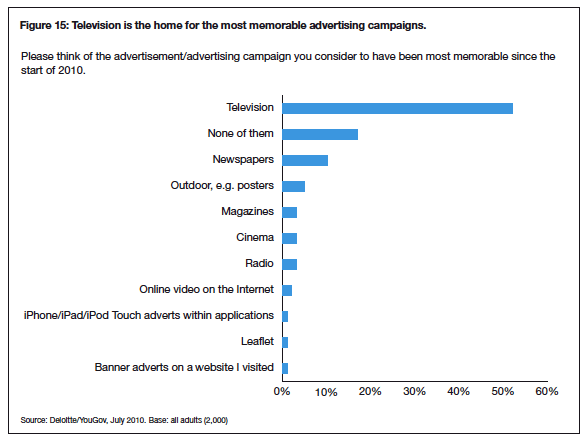
It’s a classic example of developing a methodology to make the statistics fit the story you want to tell. In its press release Deloitte state that “Online advertising struggles to make an impression” and that “television advertising still packs the greatest punch” and elsewhere “Advertising on television, still the nation"€™s favourite format”.

FWIW Here’s some of the major flaws in the methodology and reporting in my view:

  • 1 The effectiveness of different media is self-reported by end-users based on their perceptions, quite different from evaluation of actual impacts in awareness and response from established cross-media optimisation studies (XMOS) from the US
  • 2 The research asked about the SINGLE most memorable ad campaign this year – I didn’t see this acknowledged in the reporting which was generalised to ALL TV and Print ads have the greatest impact. Perhaps that was the intention of the researchers.
  • 3 Users weren’t asked about the impact of Google Adwords or other search text ad formats which account for 60%+ of UK ad spend.
  • 4 The impact of earned media through online communities like Facebook and Twitter wasn’t acknowledged in the survey or to any extent in the analysis
  • 5 The actual investment by advertisers in online media isn’t mentioned. Current Internet media ad spend is over 20% of total ad spend according to the IAB/PwC Ad Spend research
  • 6 The report also showed that 86% of viewers reguarly skipped ads on their PVRs, but this was glossed over in the press release and exec summary, although many journalists did pick up on this.

Marketing implications: Always check the methodology and sample for reported statistics. But remember that digital media still only accounts for 20% of all media, so offline media have their role. Integration is still the name of the game.

This entry was posted in Offline media integration. Bookmark the permalink.
  • http://www.deloitte.co.uk/tmt/television James Bates

    At Deloitte we are pleased that our report using the YouGov data has stimulated so much debate on blogs and in the press. That was its intention.

    Dave makes a comment at the end of his article highlighting the importance of integration, which I think he means cross media strategies and that is something I would wholeheartedly agree with. Different media have different strengths and possibilities, therefore successful campaigns play across different platforms in this way and have done so even before the advent of online. The challenge for media planners and campaign managers is to get the balance right.

    Responding to some of the points made by Dave we would add:

    1. Regarding search based advertising, we did not include this category as we did not consider this a direct competitor to display advertising. However we did poll this last year, and online search fared moderately (12% of respondents versus 64% for television) in response to the question: “Thinking about advertising that you see or hear which three of the following forms of advertising have the most impact on you?”. We expect that had we asked the question again this year, we would have had a similar outcome.
    2. As for Facebook, its principle advertising today is delivered by banner advertising. And you can see the impact of banner advertising both in terms of the responses from consumers and also in terms of current CPMs for banner adverts.
    3. We did undertake a lot of polling about the impact of social networks on television, which is covered off in one of the chapters of the report. Our conclusion was that today, television and social media / social networks have a symbiotic relationship. However over time, they may all compete for attention and for advertising spend.
    4. I’d be really interested to know more about the research quoted in the article above – “Users weren’t asked about the impact of Google Adwords or other search text ad formats which account for 60%+ of UK ad spend” – my understanding is that Google takes about £2bn of ad spend and makes up most of the search industry, and television takes £3.3 billion.

    • Dave Chaffey

      Thanks for your comment James,

      It seems we agree on one aspect : integration of traditional and digital media campaigns are most effective and co-consumption of media is increasing as your report shows.

      On your points:

      1. While I hear your rationale for not including search, it is nevertheless one of the primary ways of reaching and influencing consumers today and it does compete for users’ attention (when co-consuming in the ad breaks) and certainly with TV and print advertising budgets. It’s also worth remembering that c one third of Google’s revenue is from the content network of publisher/partner sites which is effectively a display ad buy. I would acknowledge responsiveness from this is low, but it can generate awareness when deployed correctly as can Google Adwords text ads.

      2. Facebook is also competing with traditional trad media and TV in particular. It may not be impactful in terms of recall of the single most memorable ads, but it does generate significant response and is the most important online display ad buying choice today. Not to mention the incredible engagement some brands have achieved through Facebook company pages.

      3. I’d agree with this

      4. Yes your figures seem correct. The IAB/PwC factsheet download referenced above is the source of the 60% search ad spend figure.

      I enjoyed reading the details in your report, it’s important for digital marketers to remember the value of traditional media, that’s a certainly a key message in my books/training courses.

      it’s unfortunate that the press release hooklines and print headlines always tend to select the juiciest part of the research. I think asking consumers for the single most memorable campaign was always going to suggest that TV is more effective than digital, but I guess that’s what they wanted to hear at the Edinburgh International TV Festival .

  • http://www.deloitte.co.uk/tmt/television James Bates

    Dave, thanks for the response and clarifications, very helpful.

    Just one final point which I feel compelled to clarify.
    Deloitte was not commissioned and did not receive any payment for the report. We are one of the sponsors of the Festival and as such are financial sponsors, but more significantly, in-kind sponsors,in that we do most of the research (YouGov, which is a co-sponsor, undertakes the polling), we do the analysis, we design the report, we print and we distribute it.

    We have full editorial control over this report – so everything in the report is based on peer review from our teams who work in the media industry (and also in the tech and telecoms sectors), as well as from peer review from executives in the industry. The purpose being to stimulate debate – I am happy we have done that.

    James

  • Dave Chaffey

    Thanks for the clarification James. I must admit I had assumed this was a paid, commissioned report and the tenor of my remarks may have been different if I had realised this.

    Final point on my part is that I stand by my assertion that asking an audience to provide their single most memorable campaign as a way of assessing the relative impact of different media is a methodology that is likely be miscontrued in reporting.

Feedback Form
Feedback Form