Use our hub pages as a reference to get up-to-speed on all the main digital marketing techniques. They will help you quickly understand how to make the most of the technique through definitions and recommendations on our member resources and blog articles covering strategy, best practices and the latest statistics.
Search Engine Optimisation (SEO) is arguably THE most cost-effective digital marketing technique, but also the most challenging to get right. Our SEO resources are aimed at marketers who need to ask the right questions to get better results from SEO whether they are working on SEO themselves or they have an in-house or agency SEO resource.
Success in SEO is dependent on understanding the most important SEO ranking factors which give you the best position and then working hard to perform better than competitors.
It's also important to stay up-to-date on the updates Google makes - we cover the major updates in our weekly enewsletter.
Google has some good basic resources on SEO success factors. This video is useful for small and startup businesses this video.
Google's Head of Webspam Matt Cutts also has a good video introduction which is useful when training others.
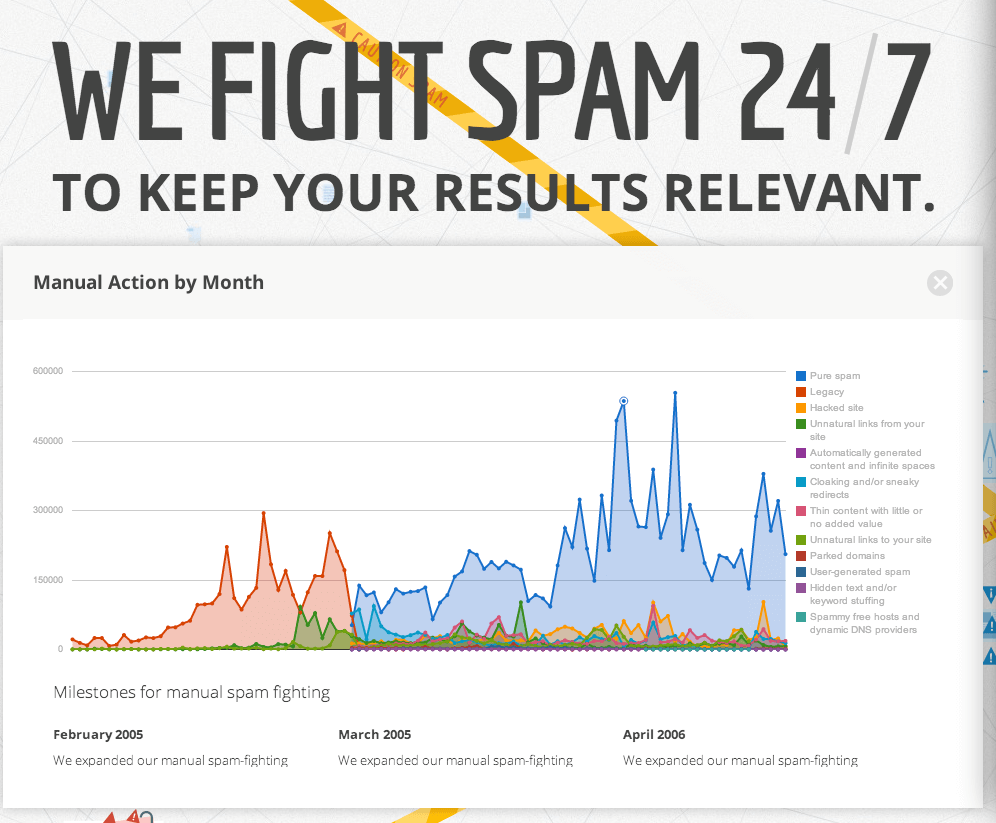
In March 2013 Google has updated this to an interactive infographic on how SEO works.
This extract shows the efforts from 2005 to 2012 to manually remove Spam.
For a more scannable form see our in-depth 7 Step Guides or this free 2012 SEO Starter Guide from Google.
Some useful new summaries of SEO best practice from 2013 are:
Search engine optimization (SEO) involves achieving the highest position or ranking practical in the natural or organic listings as the main body of the search engine results pages (SERPS) across a range of specific combination of keywords (or keyphrases) entered by search engine users.
As well as listing pages which the search engine determines as relevant for the search performed based on the text it contains and other factors such as links to the page, the SERPs also contain other tools which searchers may find useful. Google terms these tools part of a strategy known as Universal or blended search.
The Natural or organic listings are the pages listing results from a search engine query which are displayed in a sequence according to relevance of match between the keyword phrase typed into a search engine and a web page according to a ranking algorithm used by the search engine.
The main benefits of SEO are:
1. Highly targeted. Visitors are searching for particular products or services so will often have a high intent to purchase – they are qualified visitors.
2. Potentially low cost visitors. There are no media costs for ad display or clickthrough. Costs arise solely from the optimisation process where agencies are paid to improve positions in the search results.
3. Dynamic. The search engine robots will crawl the home page of popular sites daily, so new content is included relatively quickly for the most popular pages of a site (less so for deep links).
Despite the targeted reach and low cost of SEO, it is not straightforward as these disadvantages indicate:
1. Lack of predictability. Compared with other media SEO is very unreliable in terms of the return on investment – it is difficult to predict results for a given investment.
2. Time for results to be implemented. The results from SEO may take months to be achieved, especially for new sites.
3. Complexity and dynamic nature. The search engines take hundreds of factors into account, yet the relative weightings are not published, so there is not a direct correlation between marketing action and results – "it is more of an art than a science". Furthermore the ranking factors change through time.
4. Ongoing investment. Investment needed to continue to develop new content and generate new links.
5. Poor for developing awareness in comparison with other media channels. Searchers already have to be familiar with a brand or service to find it. However, it offers the opportunity for less well-known brands to ‘punch above their weight' and to develop awareness following clickthrough.
Remember also, that search engine marketing is only one online digital communications tool. For established brands, we commonly see from web analytics that more than half of site visitors arrive at a site, not through search engines, but directly through typing in the web address or following a bookmark (web analytics tools label these as ‘no referrer'). The volume of direct visitors shows the power of branding, PR and offline communications in driving visitor traffic.
We think there are 5 main types of software and tools you need to help review and improve your SEO:
These are the related techniques which we recommend as important for managing Search engine optimisation (SEO) effectively. View these hub pages giving details on best practices, statistics and examples for these techniques:
The Digital Marketing Strategy And Planning toolkit contains:



The Digital Marketing Strategy And Planning toolkit contains:
Start your Digital Marketing Plan today with our Free membership.