The Power of Facebook Likes?

New report shows the level of amplification you should expect from Facebook

I’ve written before that “fans are vanity, engagement is sanity” in relation to Facebook brand pages. A new joint report, The Power of Like 2: How Social Marketing Works produced by comScore and Facebook has been published that further stresses the effectiveness of engaged fans to a brand’s return on investment. It states

“While the vast majority of large brands today have an active social media presence, there continues to be an over-reliance on simple counting of Facebook Fans as a key performance metric.”

Whilst I am inherently sceptical of any report funded by a platform which stands to benefit financially from many of the activities it recommends, there are some genuinely useful data and insights in this report. It also digs a little deeper into Facebook’s Insights data – available to any Page owner and specifically references the metrics that make up the PTAT (People Talking About This) score.

To my mind a high PTAT is significantly more valuable than tens of thousands of fans. So what makes up this metric? PTAT measures fan engagement by counting any type of direct interaction with a Page such as initial liking, liking specific content, posting to a wall, commenting, sharing content, answering a question or checking in. Be aware that the PTAT score showing on each brand page also adds in any newly acquired Page likes (i.e. new fans) and many studies into PTAT exclude these new fan numbers as they may skew the underlying data.

So far then we have two possible metrics for measuring a Page’s effectiveness:

  • Fan numbers
  • PTAT (people talking about this) – We will call this Engagement

What else is possible?

The paper suggests two further metrics:
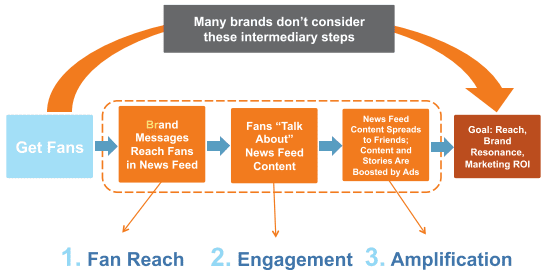
  • Fan reach
  • Amplification

Let’s review what what these KPIs mean and their relevance:

  • Reach comprises a number of segments – Organic Reach is the number of people who have seen any content associated with your Page. This may be on your wall, on their timeline (if they are a fan and if the algorithm is such that they see the content), or on their ticker. It comes as no surprise that Reach can be significantly increased by paying Facebook for Ads, Promoted Posts, Sponsored Stories. This is Paid Reach is when an individual sees your content via an ad. Each of these metrics (and many more besides) are available post-by-post in Facebook Insights.
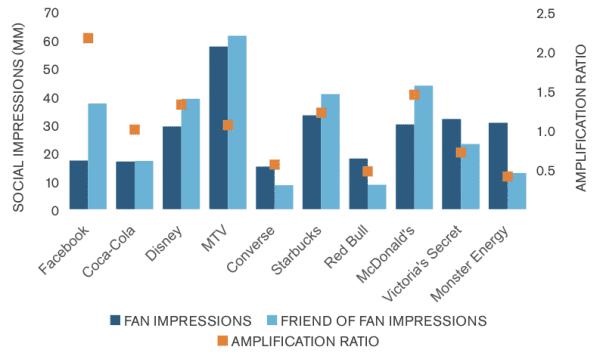
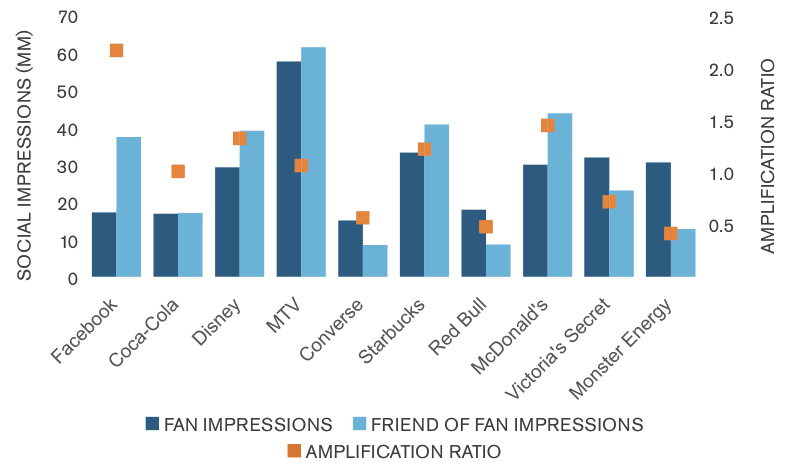
  • Amplification is probably more commonly understood in terms of viral marketing (and indeed Facebook Insights generally refers to amplification metrics as viral metrics).  The new research shows that for the top ten corporate brands in the US, the average Amplification Ratio average was 1.05 (Range: 0.42 to 2.18). Comscore describes this as “a metric that divides the number of Friends of Fans reached by the number of Fans reached with earned media, or the number of impressions reaching each of these segments“.

  • Viral Reach occurs when someone sees that content via a friend’s activity (such as a share or comment). When designing ads for Facebook, you can even select to only advertise to Friends of your existing Fans. Not only is there a proven uplift in the Sponsored Stories type ad (where an individual is more likely to click on an ad because their friend is named as liking the Page or Content), but it stands to reason that your social circle has a higher propensity to like similar things to you than the rest of the population – that’s one of the reason you are friends in the first place.

So brands are using their Fans as conduit for brand exposure to their Friends. Because the average Facebook Fan has hundreds of Friends, each person has the ability to potentially reach dozens of Friends with earned impressions through their engagement with brand messages. According to comScore and Facebook,  the average brand message from the Top 1,000 brands on Facebook is able to deliver an actual amplification of 81x if Fan Reach efforts are maximized (although the ratios shown in the graph above suggest it’s a long way short of this on average).

ROI of Amplification

The research carried out by comScore and Facebook examined the social media presence of four leading retailers – Amazon, Best Buy, Target and Walmart – to determine how their social assets were leveraged to engage, and hopefully influence, customers during American “holiday” seasons such as Black Friday.

The results showed significantly higher rates of purchase among Fans. Amazon Fans spent more than twice as much at Amazon as the average Internet user while Friends of Fans exposed to Facebook messaging spent 8% more. For Best Buy, Target and Walmart similarly strong spending indices were evident among Fans, but the brands also had stronger spending indices among Friends of Fans, (perhaps reflecting the strong promotional efforts of these three brands during the holiday season).  This empirical evidence that exposed Fans and Friends of Fans have higher spending behaviour strongly supports the importance of reaching these buyer segments. They are substantially more valuable consumers in terms of actual purchase behaviour whether or not earned media exposure actually influenced their purchase decisions (and of course this research does not categorically prove the link).

If social media ROI is of interest to you I would recommend you read the report in full. It covers far more than I have in this post. At the very least it adds to the voices calling for Engagement and Amplification to be better metrics than the vanity that is Fan numbers.


This entry was posted in Social media analytics. Bookmark the permalink.
  • Simon Thomas

    This is interesting. I’m always intrigued by whether data tells us about a cause or just a correlation. You say that the research doesn’t categorically prove a link, that is people are not necessarily buying more BECAUSE they are friends of fans or have been potentially exposed to the message. Could it be a demographic thing? They are more likely to buy because they are demographically close to their FB fan friends and therefore have a likelihood to behave the same way? You’d expect fans to be more likely to buy, which is why they’re fans in the first place. Was the research able to say that the buyers had actually been exposed to the FB messages (with Edgerank that’s now less likely)?

  • Simon Thomas

    Having now read the report, I can see that the methodology is pretty rigorous, although there’s quite a lot of inference involved (not least that an impression appearing in a newsfeed is actually seen by that person). The report does address the question of correlation or causality and states that the research doesn’t answer it. It would be interesting to see if the same test applied six times yielded the same results every time.

  • Marie Page

    Simon
    They are good questions and unfortunately none that I can answer with any authority as I’ve merely reported on the research rather than carried it out myself. The report used data and analysis from comScore Social Essentials™, comScore AdEffx™ as well as Facebook Insights. I’m assuming that one of the comScore platforms was able to figure out who of the brand’s many audiences had gone onto buy.

    And yes, we would expect a fan to be more likely to buy. The academic literature backs this up. A couple of examples: Woodcock et al (2011) covered multiple bodies of research showing relationships between engagement and value with committed consumers providing 5-8 times the value of an average consumer.

    Kim et al (2008) found that online community commitment is a driver for brand commitment demonstrating that such consumers possess stronger brand commitment than those who are not community members.

    I know from my own Sponsored Stories ads that ads shown to Friends of Fans (with the implicit endorsement that “XXX likes this”) are hugely more effective in conversion (to Facebook “actions”). What I’m unable to do, even as an ecommerce vendor, is then continue to monitor the customer journey from initial like through to purchase on another platform. Whilst digital marketing is so measurable in so many ways, Facebook presents a big challenge for small companies with limited budget and resources. For me I’m content with the sales we can directly attribute to Facebook (i.e. Google Analytics data showing a sale directly from a Facebook link) and the engagement levels we enjoy on the platform. Such engagement on a platform of the customer’s choosing has to be a good thing for the brand.

  • Simon Thomas

    Thanks Marie. I too am able to track direct sales from Facebook on GA and it works well, with conversion rates double that for email (that is, a clean database of regular customers). The Twitter conversion rate is even higher (though the quantity lower). With only 1/3 of sales made online, it’s reasonable to assume the FB effect is even higher.

    I’ve had varied results from FB advertising, some campaigns not working at all and some quite successful, with sponsored stories working well to drive likes on the brand page.

    The comscore report does describe an uplift in sales from those segments that include FB likers and friends, as opposed to the non-FB segment, in the period following exposure to ads. I’d like to see that tracked over time to see if the results are consistent but it might be reasonable to infer a cause and effect there.

    It’s good to see you focusing on the smaller, more meaningful numbers, rather than total likes. I’m always wary of the big numbers.

    • Marie Page

      Re direct sales from Facebook – I’m convinced that for us Facebook supports plenty of sales beyond the data picked up by Google Analytics. Facebook is a PR tool in this sense and as such is always going to be challenging to directly measure. When I’ve trialed measuring via customer survey (questions like “To what degree does our Facebook page influence your purchase?”) it’s no surprise that customers deny any influence at all. We know from neuromarketing research that we are rarely as aware of the impact of marketing messages as we think (see Martin Lindstrom’s Buy-Ology for more on that).

      I’m very much about focussing on the more meaningful numbers and it’s good to see some of the research going that way too. Sadly a recent webinar I attended that Facebook put on was all about increasing fan numbers and very little on Engagement rates (but hey what do I expect? That’s what justifies all that advertising).

      I’m currently working on a research project looking at what TYPE of content drives engagement. I’m focussing on small brands (partly because that’s where I work and because I think our behaviour as fans changes depending on whether we are looking at big brand pages or small brand pages – I might like a big brand page for the kudos or info it brings to my wall, but I’d rarely comment on its content or liking individual posts).

      Will write up the results in future posts here I’m sure.

      • Simon Thomas

        I look forward to seeing that Marie.

  • Pingback: The Power of Facebook Fans

  • ricardo hocine

    kakà ♥

Feedback Form
Feedback Form