Master Marketer Seth Godin on marketing today
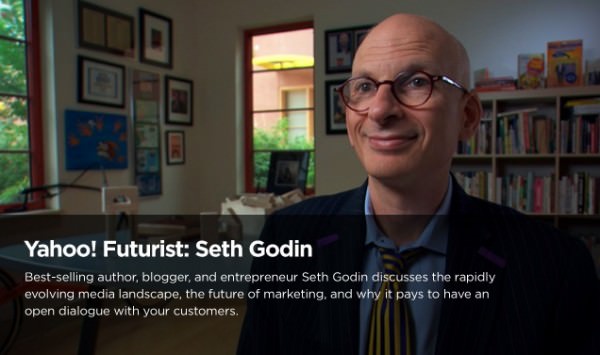
"The internet is not TV 2.0". You gotta love Seth Godin - considered, candid and rich with insight. I found this video yesterday and thought it was worth sharing. Why? A lot of my conversations I have with other marketers follow similar themes...
- "PPC ads does not work like they used to, I can't scale it up"
- "Banner ads don't work for us at all, we don't get the clicks"
- "How do we get social media marketing right"
This video resonated with me, not just because I've learnt from Seth for over 10 years, but because he succinctly addresses the bigger problem that marketers face and then outlines the solution in only 10 minutes.
 What are the take-aways?
Revolution not evolution
Revolutions are initially perceived impossible - Seth reminds us about Henry Ford and how the first mass production car changed the world and paved the way to a totally different landscape, in every sense. Imagine the concept of roads running everywhere with cars on it before they were invented. It would sound impossible. And, all because Henry Ford created a way to develop a vehicle with interchangeable parts.
Our revolution is the internet, but Godin insists that we are missing the point with two common thought processes:
- "the internet offer the opportunity for TV ads online, cheaper or even for free" - wrong
- "the internet is great for marketing average products to average people in a new exciting and hypeful way" - wrong
Transparency
If you do a search on a brand you'll find opinions about it, same with a book - there will be a handful or maybe hundreds of reviews. 10 years ago the info came to you from the company, now we get the truth, and often that news finds us without us requesting it via social networks. Did you imagine this 10 years ago?
It's better to bet on marketing in a new and open way in a world that's leading to open, there are no secrets anymore. Ask Rupert Murdoch.
Advertising does not work in a linear way
"We have the product, now go and sell it by putting a gloss on it". You spend, you get - simple? The advertising heroes in '63 had money and a unique moment in time (the TV-industrial complex) they could buy out the marketing challenge, and as marketers Seth is saying that we're still trying to follow the same model. It was a totally different environment where the competition could be simply out-spent. Yet this linear thinking cannot work in the competitive and noisy online space. Banner ads or PPC don't scale or work in a spend-to-get way - they can though act as an amplifier for what is already working.
Nobody cares about our brands. Nobody's waiting for spam email updates or press releases. The product is the marketing, the marketing team (the story-tellers) should be in charge of product in order they can influence the making of stuff that's remarkable and so marketable.
The internet is the lever, it's the beginning not the end point. A means to connect and do business in a totally different way. It's not TV 2.0.
Seth's suggestions
- Tell 10 people, focus on 10 who trust or like you already, if you can inspire those 10 to tell their friends then your message has scale. Internet media spend is not a shortcut to over-coming the first 10 problem, yet it can work is an amplifier for what already works. Why does the first 10 method work? Humans are still humans - no change. Facebook works because we all deeply care what people say/think about us. Twitter works because we want to be listened to, to have our ideas shared and spread
- The deliverable from the first 10 thinking is not the sale, it's permission to follow up. There's so much media to invest in today that if it doesn't work fast enough we'll cut it out, instead internalise the shift that's happening. People are online, companies need to change to be online with them.
- What you do well or did well, does't matter anymore. The industrial complex is falling apart because we can search online and buy cheaper. So, create products worth talking about, enable conversations, make stories, build tribes - don't buy media until you can do these points well!
- The only asset built online is permission - the right to talk to people who want to be talked to, to have a relevant, anticipated and personal message for them, to help them talk to connect to one another over brand videos thumbs up or Likes
- Measure every interaction
Watch the video and share what you think, could this approach be something you take into your organisation?