Email campaigns we can learn from
“…the eye, tends to be impatient,
craves the novel and is bored by repetition”
W. H. Auden
Effective email marketing engages recipients, ultimately leading to more sales by delivering the right message to the right person at the right time.
Customers would rather see a beautifully crafted email appear in their inbox than a bad one.
Big brands can have a slightly easier email marketing task than smaller brands - an email from Amazon, Barclays, ASOS, or John Lewis already carries with it an expectation of what you will receive.
So, it's unforgivable for a big brand to take customers for granted.
Abercrombie & Fitch’s Christmas email campaign
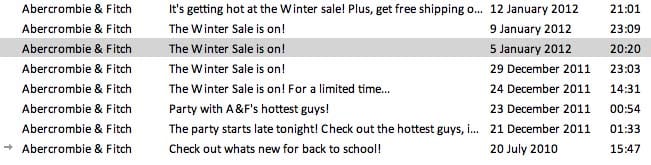
Here’s a snap shot of my inbox showing all Abercrombie emails received over December and January:
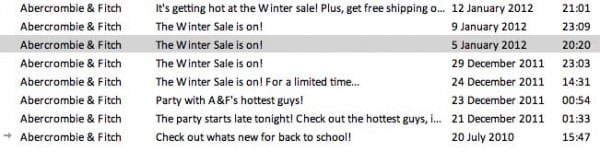
You will notice the central subject line theme is “The Sale”
From the first Christmas Eve email, I understood the sale had started. The second email, on 29th January, reiterated this point. Okay; it may just have slipped my mind.
However, to hammer home the same message in three subsequent emails was really just lazy. Are there really no other USPs that could have been included?
I’m all in favour of occasional rule breaking because it allows you to stumble across innovative ideas. However, there are certain email rules that should never be broken…
1. Subject line length
Stick to around 50 characters, including spaces, to ensure your message is heard. Abercrombie’s final 12th Jan email subject line is 67 characters long, causing the message to be be cut short.
2. Avoid using spam words
Avoid using spam words in emails because spam words trigger spam filters and your carefully crafted email will end up in the junk box.
Be careful when using the F word (Free) - especially in the subject line.
3. Tailor emails to the target audience
Now I like a ripped torso as much as the next man but is this image really going to make me part with my cash?
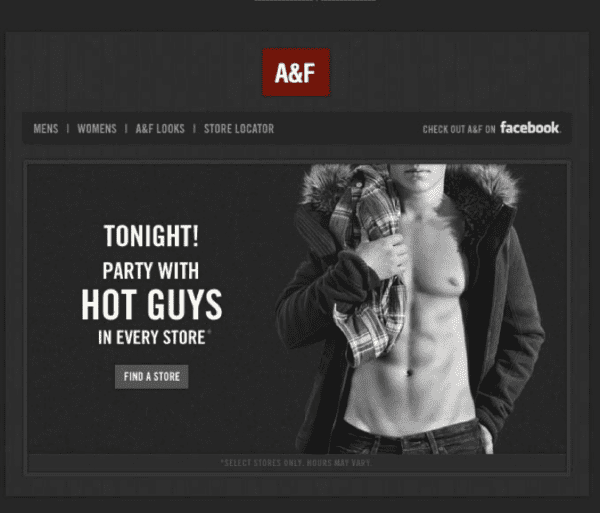
Abercrombie’s website contains many fabulous images, so why send me the same images 7 times?
4. Segmentation and personalisation
Audience segmentation is really important if you want to personalise your communications.
Studies show open rates increase when you personalise emails so email body copy personalisation improves your chances of clickthrough and purchase.
Conversely, personalisation gone wrong can have a devastating impact on email open and clickthrough rates so, as a rule of thumb, if you are unsure then leave it out.
Abercrombie’s kind offer to me (a middle-aged father of two) to “party with Hot Guys” might have been avoided if someone had simply looked at my [Title]. An email link clicked through to a landing page showing the stores where the ‘Hot Guys’ were working, with no reference to the geographical location of the recipient.
Is Abercrombie (or its agencies) deliberately trying to make it difficult to stay engaged with its brand?
This email campaign made it feel like customers must persevere, jumping through lots of irrelevant hoops, to achieve success at the journey’s end. The Christmas campaign might just reflect an absence of joined up thinking in connection with what is, I think, an exciting brand. You decide.
Top 6 techniques to get email marketing right
1) Objectives. What exactly are you looking to achieve; sales, dialogue, information.
2) Your data. Try to understand what data you have and group them together; male, female, location, age, interest, etc. If you can’t, that’s fine – just remember this for 3 and 4 below.
3) Copy. Starts with understanding your customers. What are their drivers; i.e. money, lifestyle?
4) Design. A well-designed email will capture peoples’ attention more than 1000 words ever can. But design and copy must work tandem.
5) Test your emails with various subject lines. Remember ‘from’ and ‘subject line’ are the first hurdle to getting your email opened. Split A/B testing is the best, but if you really must send it to the same person, make each alteration to these elements more significant and space out the timings.
6) Optimise. Feed previous email results into preparing for the next one. Learning from your mistakes is as important as learning from success.
Well, that's what I think, I hope you find my tips valuable.

Thanks to
James Hart for sharing his advice and opinions in this post. James is a Digital Marketing Consultant for
Key Multimedia. He has over 20 years digital and traditional marketing experience gained within Blue Chip financial services companies, including; Barclays, Halifax and Zurich. James’s specialisms include Email Marketing, Content Marketing, Social and Analytics. You can
follow James on Twitter.